
A Fireside Chat with Prof Amy J Ko
On visibility, belonging, and reimagining computing for everyone
In celebration of Pride Month, Adriana Wilde speaks with Prof Amy J Ko about identity, belonging, and what it really means to create equitable learning spaces in computing. Amy is a celebrated scholar known both in the Human-Computer Interaction and Computing Education Research communities. Her approach to studying humans’ individual and collective struggle to understand computing, working toward an equitable, sustainable, and fair future is an important message for us all, to highlight and celebrate in the month of June.
Adriana: Amy, thank you so much for agreeing to take part in this, it’s a real pleasure. I’ve started following your work since we met at the ACM International Conference on Computing Education Research (ICER) in Melbourne, and I have found it very inspiring. Especially your reflections on identity and belonging in computing, as shared in the YouTube interview you gave to Liz Gerber three years ago, on her Technical Difficulties Podcast, entitled “Code is about Power, Positionality, & Creativity”. As part of my teaching on Diversity in HCI, I play my students a clip from minute 7:20 where you talked about a “deep void for a group affinity in your life”, and ones’ position in the world, how one fits in, which I found very powerful and clear to illustrate the concepts of identity, intersectionality and positionality. I’d love to start there: what does it mean, in your view, to be part of an “underrepresented group” in computing today? And have your views shifted over time?
Amy: Thanks Adriana, that’s a very interesting question!
For me, I think the concept of underrepresentation feels very disconnected from individual experience. It’s a word that’s always implied to me that there’s some preferred level of representation, like a kind of administrative goal set without consultation of the students being invited into CS learning spaces, and without attention to any of the actual problems in CS culture. For example, in my case, it’s not that I need more white/Asian transgender Pacific Northwesterners in my university to feel like I belong. That would be a very strange goal, because there’s nothing inherently good about having a certain proportion of that group in a university. And even framing it that way feels like tokenizing, because I am not fully defined by those labels. And neither are students who are Black, Hispanic, women, disabled, poor, rural, autistic, or any other intersecting group we might define as “underrepresented.”
Representation itself also isn’t a particularly helpful goal. I think we’ve all seen how the greater visibility of trans people in society has only led to backlash. The conservative right in the 2024 U.S. election spent a quarter billion dollars on anti-trans ads, spreading lies and hate, and so most of that visibility has been harmful. In the same way, many non-white and non-Asian students in CS have been elevated by CS departments over the past 15 years of broadening participation efforts but often in ways that tokenize them, all while doing little to change the harmful aspects of CS culture in education or industry.
What CS really needs is not representation, or even mere inclusion, but to be reimagined around ways that reflect the beautiful diversity of humanity. CS is, after all, for everyone, not just for the wealthy white Western men who tend to dominate it. That requires far more than representation. I think in those futures, there’s space for everyone, in any proportion, and all of our differences are seen and valued, independent of how dominant groups might want to label us.
“What CS really needs is not representation, or even mere inclusion, but to be reimagined around ways that reflect the beautiful diversity of humanity.” — Amy J Ko
Adriana: That’s a really powerful reframing. I agree that without culture change, increasing representation of minority groups will not necessarily result in an increased sense of belonging. At the same time, I find myself still wondering about the role of visibility, especially for students starting out. There’s that familiar adage that goes “if you can’t see it, you can’t be it.” Do you see any value in representation as a signal of belonging, even if it’s not enough on its own?
Amy: I think the intuition is right: of course seeing people like ourselves might be a good indicator of the safety, viability, and relevance of being in a CS learning space. This can be true of more visible identities than invisible ones. For example, if you see a student in a wheelchair in class, easily accessing the room, engaging in learning with teachers and students, that’s one clear signal that students with mobility issues are included. Of course, that doesn’t mean they are always included and always have the resources they need to learn — it’s just a proxy for an individual’s broader experience.
For invisible and less visible identities and lived experiences — cis-passing trans students, neurodivergent students, students with chronic illness, students with learning disabilities, students in poverty, students who are unhoused — there aren’t such clear clues. That takes other students, faculty, and staff being out about their differences. And that is less common, because of stigma. So students who might share some experience or identity with others might never know, and feel isolated, even though solidarity and community is within reach.
Working towards truly equitable CS learning spaces means going beyond visibility. It means everyone in a community having cultural competence about the diversity of human experiences, and intentionally designing learning spaces that account for that diversity. That’s the only way that all students will have consistent, ongoing inclusive and equitable experiences in learning. And in those spaces, visibility doesn’t matter, because the collective cultural competence of a learning space will be visible and plain in how it is organized. As an example, I don’t think we do a great job of realizing it yet, but in our Information School, we have the word “sovereignty” in our list of values, and classes about sovereignty in our curriculum. It certainly is essential that we have Native faculty to ground our school’s teaching and expertise, and that comes with visibility, but it is also important that learning about sovereignty is part of our curricula.
Adriana: Your reflections on visibility also made me think of trailblazers in computing, people like Lynn Conway, whose work and personal journey have had such a profound impact both on technology and trans visibility. Were you aware of figures like her before or during your own journey of self-understanding? And more broadly, how you think about the courage it takes to move towards your own self, especially when social change can feel slow, uneven, and at times resistant?
Amy: As a pre-internet child of the 1980’s, I had little to no awareness of any trans people or of computer science. My world was mostly shaped by the media I saw (which framed trans and gender non-confirming people as people to be laughed at and bullied), and by the books I read (e.g., programming books I found at Powell’s book store in Portland, stereotyping 90’s movies about hackers). Once the internet came to life in the early 2000’s, I learned that I wasn’t alone, but most of the content online was discussion forums of trans elders who often led with dated notions of gender performance. I did stumble upon Lynn Conway’s U Michigan page, and parts of her story (IBM firing her, the government denying her access to her children), and that mostly scared me. And of course I found many tech bro-ey places online about programming, but they felt aggressive, competitive, and hostile, so they didn’t resonate with me.
Adriana: But what did it all mean for you then, and your decision to come out at work?
Amy: All of that meant that if I was going to be myself, it meant either being myself secretly, or being on the front lines of social change like Lynn was, and building upon the work of activists that came before. Once I realized I’d rather be dead than hide any longer, I knew I had to come out. And that meant dealing with all of the ways that CS can be transphobic, sexist, racist, and ableist. I still remember the first conference I went to after coming out; someone I’d known for 15 years came up to me, didn’t recognize me, and asked if I was visiting with my husband. Welcome to womanhood!
Adriana: Oh yes, I think we’ve all heard a version of that question, sadly. Welcome indeed to being a woman in computing.
Amy: Ultimately, I critique CS, and work to change CS because I still think computing is a fascinating and fraught tool of human expression, and something we should all know something about. If I didn’t care so much about sharing that knowledge, I would have left a long time ago. I hope others take the critical views I have of it in the same way we should be self-critical in a democracy: we protest, fault, and reimagine the places we live, because they are our homes, and we want to continue living in them.
Adriana: What a good reflection to conclude this conversation with! Thank you so much, Amy for your time but above all, for your invitation to critically reconstruct our discipline to achieve true inclusion. While representation matters, it is not enough on its own. If we want computing to be genuinely inclusive, the work goes deeper: into the cultures, practices, and assumptions that shape how and for whom it is taught. As we mark Pride Month, it leaves us with a broader question: not just who is visible, but how we design spaces where people don’t have to rely on visibility in order to feel that they belong.
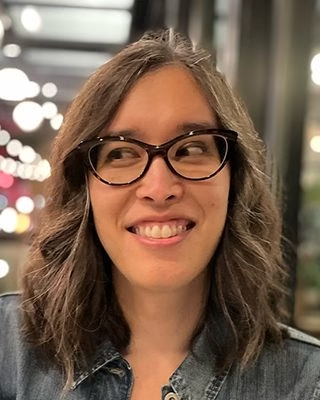
Prof Amy J Ko is a Professor in the Information School at the University of Washington. Her research focuses on computing education, human-computer interaction, and the ways in which computing can better serve the full diversity of human experience. Through her scholarship and advocacy, she continues to challenge and reshape how we think about belonging, equity, and the future of computing.
Dr Adriana Wilde is Director of the Centre for Health Technologies at the University of Southampton and ACM‑W Communications Co-chair. Her work spans human-computer interaction, digital health, and inclusive computing education, with a strong commitment to fostering environments where diverse identities, perspectives, and trajectories are valued and supported.