
Voices of ACM-W: Shaundra Daily on Embracing Diversity: Transforming Computing Education for All
By Cigdem Sengul
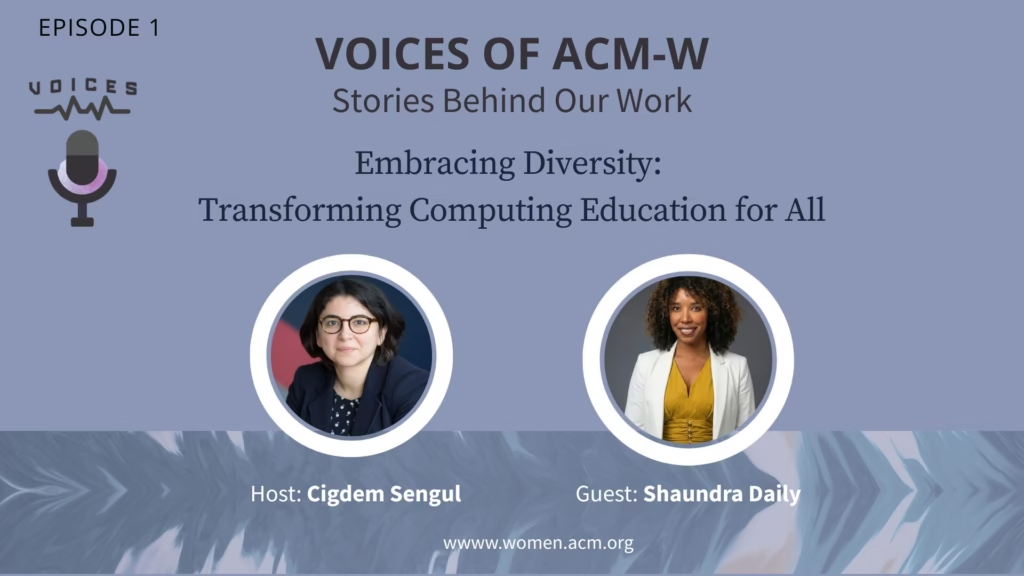
Are you wondering how diversity and inclusion shape the future of computing? This month’s Voices of ACM-W conversation with Dr Shaundra Daily, a celebrated computing education researcher, offers powerful insights into how our field can become more equitable, welcoming, and impactful not only for women but for everyone. Inspired by the IWD (International Women’s Day) theme – Rights, Justice and Action. For ALL Women and Girls – our conversation explored how to tackle structural barriers, harness the potential of AI, and build community-driven spaces. We also discussed actionable strategies to foster belonging and drive social change through computing.
The Power of Interdisciplinary Spaces in Breaking Barriers
One of the recurring themes in Dr Daily’s work is the importance of creating spaces that transcend traditional disciplinary boundaries. She emphasises the role of environments like the MIT Media Lab, which intentionally embrace interdisciplinary collaboration to foster innovation and inclusion.
Why do such spaces matter?
Standard academic environments often reflect rigid hierarchies and narrow definitions of expertise, which can exclude diverse identities and ways of knowing. By designing spaces that support multiple ways of learning and creating, such as through combining arts, dance, social justice, and technology, we empower individuals who might otherwise feel alienated.
Key strategies include:
- Developing programs that integrate cultural and social identities with technical skills
- Creating physical and social counter spaces where marginalised groups can see themselves as valued members of the community
- Supporting faculty and staff to adopt culturally relevant pedagogy and intersectional approaches
These approaches cultivate a sense of belonging, encourage innovation, and help dismantle the structural barriers that often hinder participation.
Structural Barriers and the Need for Systemic Change
Dr Daily highlights a critical insight: individual resilience is not enough. “Barriers are embedded in the structures we create,” she says, referring to funding priorities, hiring practices, publication norms, and curriculum design.
What does this mean for institutions?
- Structural change requires intentional policies that value diverse research questions and methodologies
- Creating nurturing environments involves rethinking hiring, evaluation, and resource allocation
- Focusing on metrics that go beyond traditional Key Performance Indicators (KPIs), such as diversity in graduation rates and community engagement, leads to more inclusive outcomes
To truly cultivate inclusive spaces, institutions must embed structural commitments into daily practices. Dr Daily suggests that belonging is not a feeling to be manufactured through events, but a result of sustained, systemic efforts.
Effective interventions include:
- Rethinking curriculum design to reflect diverse cultures and identities.
- Building peer mentorship and community support programs that are intentionally inclusive
- Regularly analysing who participates, who is supported, and who is left out, with a focus on intersectionality
For example, Duke’s Technology Scholars Program demonstrates that investing in peer networks, mentorship, and hands-on experiences can significantly increase graduation rates for underrepresented students – the graduation rates of women-identifying students increased from 23% to 37% by aligning institutional policies with these principles.
Key insight:
Reimagining institutions as welcoming to all requires a holistic approach that considers policies, culture, community, and individual agency.
The Role of Community and Cross-Generational Support
Supporting diversity isn’t only about policies; it’s about fostering genuine community bonds. Dr Daily shares her experiences with groups such as the National Society of Black Engineers and community programs such as InventSTEM (Daily, 2025), which bring together students, caregivers, and mentors.
Why are these spaces transformative?
- They affirm identities as assets, not liabilities
- They provide role models and mentorship opportunities
- They encourage family involvement, which can influence choices and aspirations
For instance, the cross-generational teams in Invent STEM allow parents and children to learn together, shifting power dynamics and reinforcing confidence. This dynamic helps challenge societal stereotypes that can limit women and minorities from pursuing or remaining in STEM.
What can educators do?
- Facilitate programs that include families or communities directly in STEM activities
- Design interventions that acknowledge and incorporate cultural and social identities
- Promote collaborations that break down barriers at both individual and structural levels
Reimagining Computing and AI for Equity and Justice
The dawn of advanced AI and machine learning presents both opportunities and risks. Dr Daily emphasises that AI can democratize education but also risks amplifying existing inequities if not carefully managed.
Potential risks range from data biases that disadvantage marginalised groups to accessibility barriers such as high internet bandwidth requirements or costly devices. We also must be wary of misusing AI assessments that reinforce traditional testing norms.
However, there are also opportunities. These involve using culturally relevant and diverse datasets to train AI, ensuring broader applicability. We can design AI tools that support personalised and inclusive learning experiences. Furthermore, we need to engage educators more in shaping AI’s development to reflect societal values and principles of justice.
The goal should be to develop AI that enhances human relationships, supports social-emotional learning, and amplifies diverse voices rather than replacing the relational aspects of education.
The Future of Computing: Justice, Creativity, and Cross-Disciplinary Innovation
In closing, Dr Daily advocates for a perspective where computing is accessible, relevant, and inclusive. She emphasises that every person, regardless of their identity, has valuable contributions to make, and that computing should serve societal needs in fairness and justice.
Her advice to herself and young professionals:
- Recognise that the right to belong is foundational, not contingent on proving worth to gatekeepers
- Leverage cultural and social assets as strengths, not barriers
Final reflection
The heart of inclusion is systemic change: creating environments where everyone belongs is an ongoing, collective effort. As educators and advocates, we have the power and responsibility to build counter spaces, challenge norms, and enable a computing culture rooted in rights, justice, and action. Let’s continue to push for policies, spaces, and technologies that promote justice and diversity in computing.
Listen to the Full Conversation
Our Guest
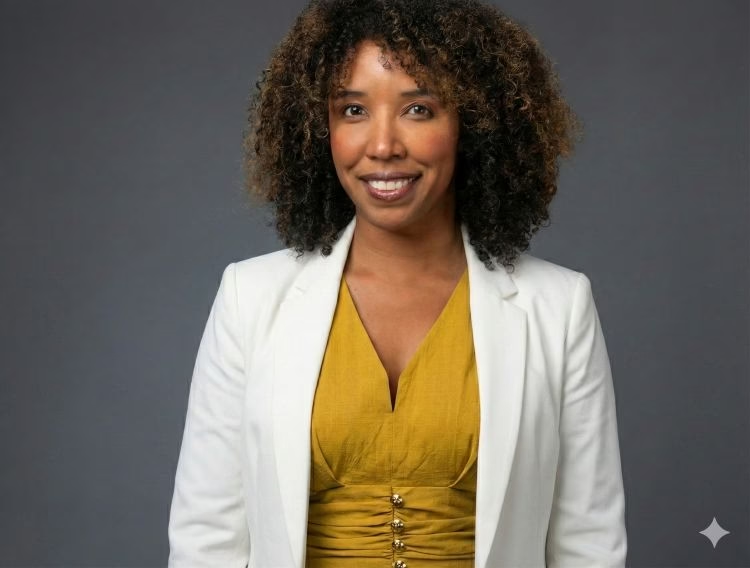
Shaundra B. Daily (she/her) is the Cue Family Professor of the Practice of Electrical and Computer Engineering at Duke University. She is also co-founder and chief product officer of KidzHack, LLC. Prior to joining Duke, she was an associate professor in the Department of Computer & Information Science & Engineering at the University of Florida. She also served as an associate professor and interim co-chair in the School of Computing at Clemson University. Dr Daily earned a B.S. and M.S. in electrical engineering from the Florida Agricultural and Mechanical University – Florida State University College of Engineering, and a S.M. and PhD from MIT Media Lab.
References
Daily, Shaundra Bryant, and Wanda Eugene. “Preparing the future STEM workforce for diverse environments.” Urban Education 48.5 (2013): 682-704.
Daily, Shaundra Bryant, et al. “Reclaiming Space: Fostering Inclusivity for Women in Engineering Fields.” 2025 ASEE Annual Conference & Exposition. 2025.
Daily, D.S. (2025) Spring fun loading…, Linkedin.com. Available at: https://www.linkedin.com/posts/shaundrab_spring-fun-loading-inventstem-where-activity-7406389315112423424-sjXQ/ (Accessed: 4 March 2026).
Kingery, K. (2024) InventHERs Institute Lets Local Underrepresented Girls See Themselves in STEM |, Duke Pratt School of Engineering. Available at: https://pratt.duke.edu/news/inventhers-institute-lets-local-underrepresented-girls-see-themselves-in-stem/ (Accessed: 4 March 2026).
Leonard, Alison E., et al. “Coding moves: Design and research of teaching computational thinking through dance choreography and virtual interactions.” Journal of Research on Technology in Education 53.2 (2021): 159-177.
Leonard, Alison E., and Shaundra B. Daily. “Dancing Codes: Stories of Boys Exploring Computational Thinking Through Dance.” International Journal of Education & the Arts 26.6 (2025).
Parmar, Dhaval, et al. “How immersion and self-avatars in VR affect learning programming and computational thinking in middle school education.” IEEE Transactions on Visualization and Computer Graphics 29.8 (2022): 3698-3713.
Parmar, Dhaval, et al. “Programming moves: Design and evaluation of applying embodied interaction in virtual environments to enhance computational thinking in middle school students.” 2016 IEEE Virtual Reality (VR). IEEE, 2016.
Washington, Alicia Nicki, Shaundra Daily, and Cecilé Sadler. “Identity-Inclusive Computing: Learning from the Past; Preparing for the Future.” Proceedings of the 53rd ACM Technical Symposium on Computer Science Education V. 2. 2022.