
ACM-W Rising Star Award Recipient: Maria Christakis
ACM-W would like to announce Dr Maria Christakis as this year’s recipient of the ACM-W Rising Star Award! The ACM-W Rising Star Award recognises a woman whose early-career research has had a significant impact on the computing discipline.
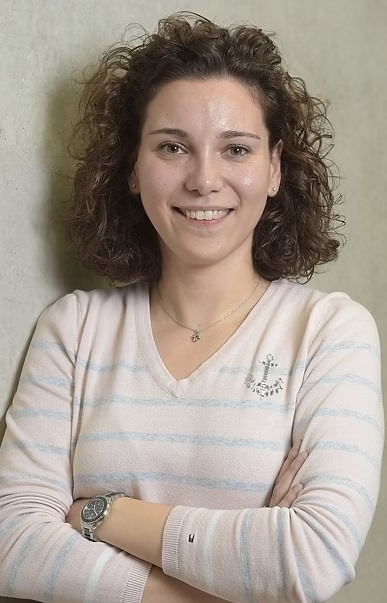
Maria Christakis is a professor at TU Wien, where she leads the Software Engineering research unit. Her research develops techniques and tools to improve the reliability and trustworthiness of software, with contributions spanning program analysis, verification, testing, and debugging.
Before joining TU Wien in 2022, she held research positions at the Max Planck Institute for Software Systems, the University of Kent, Microsoft Research, and ETH Zurich. Her work has been recognized with an ERC (European Research Council) Starting Grant, WWTF (Vienna Science and Technology Fund) and FWF (Austrian Science Fund) grants, a Google Research Scholar Award, and an Amazon Research Award. She is also a member of the Young Academy of the Austrian Academy of Sciences.
Congratulations on receiving the ACM Women Rising Star Award. Looking back, what key moments or decisions have shaped your journey into computing?
Thank you! Looking back, what drew me to computing was the combination of curiosity, creativity, and practical impact. I liked that it offered a way to understand how things work, but also to improve them in meaningful ways.
A big part of my journey has also been the people around me. I have been very fortunate to learn from wonderful mentors and to work with inspiring collaborators and students. Their support, encouragement, and example have shaped me in many ways.
Over time, I found myself increasingly drawn to work that can make software more reliable and useful in practice. That connection between research and real-world impact has been a strong source of motivation for me.
Your work sits at the intersection of software engineering and formal methods, with a focus on testing, verification, and program analysis. What core problems are you trying to solve, and why do they matter today?
At the core, I am trying to help make software systems more reliable and trustworthy in practice. As software becomes part of more and more important aspects of our lives, we need better ways to find bugs, understand system behavior, and give developers tools they can actually use.
My work focuses on testing, verification, and program analysis with that goal in mind. Sometimes that means designing better ways to test and evaluate the tools we already rely on. Sometimes it means combining different analysis techniques so they can complement each other and find bugs more effectively or more efficiently. And sometimes it means adapting these ideas to newer domains such as smart contracts, machine learning, or zero-knowledge infrastructure, where failures can have especially serious consequences.
Overall, what motivates me is the connection between foundational research and real-world impact.
Your ERC Starting Grant focuses on “Testing Program Analyzers Ad Absurdum.” What is the vision behind this project, and what do you hope it will change in the field?
The vision behind the project is to stop treating program analyzers as tools that are beyond questioning. We increasingly rely on them to assess whether software is correct and secure, yet they are highly complex systems themselves and can contain serious bugs. My goal is to develop practical, systematic ways of testing these tools by asking not only for their answers but also for the reasons behind them, and then using those reasons to uncover contradictions.
This project is part of a broader line of work my group has been pursuing since 2018, during which we have uncovered hundreds of soundness and precision bugs in analyzers and solvers. What I hope it will change is the mindset of the field: testing analyzers should become a normal and expected part of their development and, as a result, improve confidence in the critical software systems that depend on them.
Your work combines deep theoretical foundations with practical tools and systems. How do you see your work influencing the way developers build, test, and reason about software in practice?
I hope my work helps make analysis and testing tools both more reliable and more useful in practice. Developers increasingly depend on these techniques, but it is not always clear when their results can be trusted, how well they scale, or how well they extend to newer, critical domains.
I see this influence in several ways: by improving the tools themselves, for example, by uncovering bugs in analyzers and solvers; by combining different techniques so that they can find problems more effectively or faster; and by adapting these ideas to areas where reliability is especially important.
Ultimately, I hope this contributes to a development process where reliability is more naturally built in and where developers can place greater confidence in the tools and techniques that support them.
Based on your journey and experiences, what advice would you give to aspiring researchers looking to make the most of their time in academia?
My main advice would be: do not give up too easily. Research often takes time, and progress is not always visible right away. There can be a lot of uncertainty, and many things do not work on the first try, so persistence really matters.
I would also say: just get started. It is easy to wait until you feel fully ready, but in academia, a lot of learning happens by doing, by trying things, making mistakes, and gradually finding your way.
And finally, find people you trust and enjoy working with. Good mentors, collaborators, and peers can make an enormous difference, both professionally and personally.
Building on that, and thinking more broadly about the research community, what changes—at any level—would make the biggest difference in supporting and inspiring more women to pursue and thrive in computing?
I think one of the most important things is representation. Seeing people you can relate to doing well in the field makes a real difference, especially early on. It helps make a career in computing feel more possible and more welcoming.
Another important factor is support at key moments. Small things, such as encouragement, good mentorship, or simply someone taking your work seriously, can have a lasting impact. These moments often shape whether people feel motivated to continue, and they can be especially important for women early in their careers.
More broadly, I think it is important to create environments where people can focus on their work without constantly having to prove themselves. That includes fair evaluation, inclusive collaboration, and being mindful of different career paths and life circumstances.
Overall, even relatively small changes in everyday interactions can make a big difference in helping more women enter and stay in computing.
Thank you for sharing your journey and insights with the ACM-W community. We look forward to seeing the continued impact of your work!