
U-RISE — Professor Geraldine Fitzpatrick: Following the Thread of Care for People and Technology
An unconventional journey into the world of computing and academia
By Fawzia Kara-Isitt
Some journeys into computing follow a clear and structured path. Others emerge through curiosity, circumstance, and a willingness to seize opportunities as they arise — then applying one’s core strengths and passions to shape the path forward. Sometimes, the most powerful journeys are not defined by sharp turns, but by a quiet, consistent thread of an intention that weaves its way through every decision, every role, and every moment of growth, right from the start. For Professor Geraldine Fitzpatrick, that constant ‘red’ thread has always been care.
When our ACM-W U-RISE series set out to explore unconventional paths into computing, her story stood apart because it was deeply intentional — a journey shaped not by chasing titles or milestones, but by an enduring commitment to people.
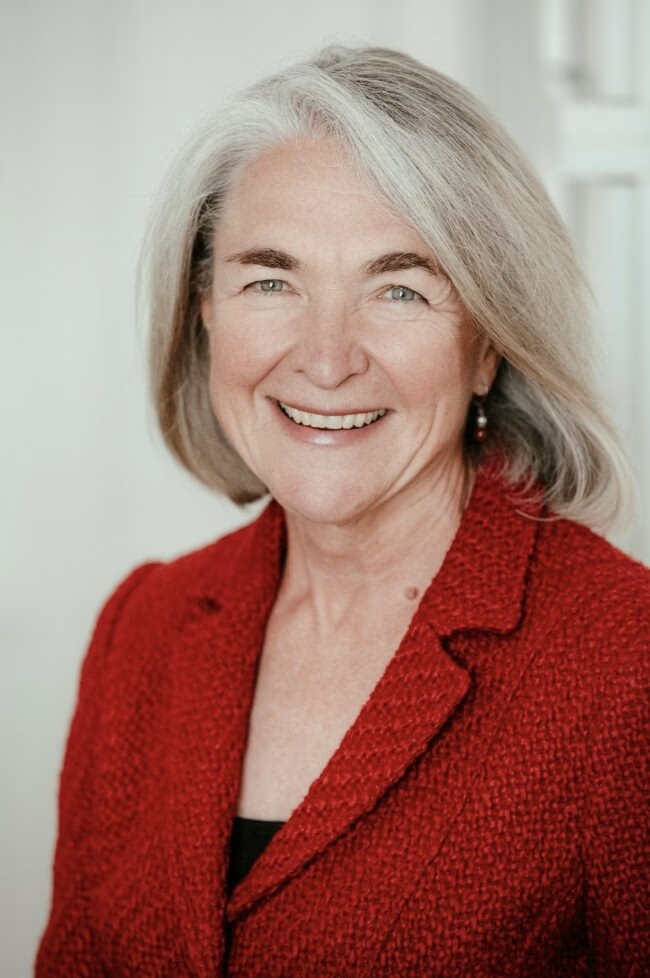
A Journey into Computing Shaped by a Consistent Focus on People
Geraldine Fitzpatrick’s journey – which spanned nursing and midwifery, computing, working in industry and academia, and latterly a psychology masters and consulting – was not defined by a single strategic decision or a long-term plan. However, what connected each stage, through all those paths, was her giving nature: a commitment to healing, supporting, and bringing out the best in people and to designing technologies that adapt to the complexities of people’s everyday lives.
From the moment our conversation began, there was an immediate sense of warmth and generosity. Fitzpatrick had not initially set out to work in technology. Today, she is a global name and a leader in the world of computing: “It wasn’t, well, a carefully planned thing,” she said with a little laugh.
When she first started a science degree, she described choosing courses, often from psychology or physiology, based on interest and scheduling rather than an aim-defined career trajectory, and they are all somehow connected to being people-based. She then switched to a computer science degree for pragmatic family reasons, thinking she could revert to the science path if it didn’t work out. That openness to trying something new ultimately led to a whole career in computing, linking all her past experiences in the medical sciences as well, such as her HCI research connecting clinical care, health and well-being.
Her path reflects a different question: “Where can I make the most meaningful difference?”
Her approach to computing has never been solely about systems or outputs, but about people and how they experience technology, how they collaborate, and how they flourish within it.
“I’ve always been oriented ‘people’ things.”
This orientation underpins Geraldine’s core work within computing. This approach wasn’t always widely accepted, though, in more technically or theoretically oriented computing fields, and she talked about sometimes holding back her ideas, feeling that there was no room for them.
Contributions to Research and Community
Today, Geraldine Fitzpatrick is internationally recognised for her contributions to human-computer interaction, collaborative systems, and research culture. Her work spans academia, industry, and healthcare, reflecting a uniquely interdisciplinary career grounded in people-centred computing. Over the course of her career, she has made significant contributions across:
- Human-Computer Interaction (HCI)
- Computer-Supported Cooperative Work (CSCW)
- Social and collaborative systems
- Digital health and wellbeing technologies
- Research culture, academic mentoring, and community-building
Her impact has been recognised through several distinguished honours and roles, including:
- SIGCHI Lifetime Service Award (2022), recognising sustained and significant contributions to the global HCI community
- IFIP TC13 Pioneer Award (2019), honouring leading contributors to the development of human-computer interaction
- IFIP Fellow (2020), awarded for outstanding professional standing and contributions to the field
- ACM Distinguished Scientist / Member (2016), recognising significant impact on the computing discipline
- ACM Distinguished Speaker, contributing to international research dissemination
- Professor of Technology Design and Assessment and Head of the Human-Computer Interaction Group at TU Wien
Beyond these formal achievements, Geraldine has played a defining role in shaping research cultures. Through initiatives such as the Changing Academic Life podcast (since 2016), alongside her work in mentoring, leadership development, and academic wellbeing, she has created spaces for more open, supportive, and human-centred approaches to computing. Through her conversations, she brings to light often unspoken aspects of academic life, including loneliness, imposter syndrome, and the emotional realities that many carry but rarely share, thus creating space for reflection, connection, and a more compassionate academic culture.
Her work highlights the importance of understanding what enables individuals to do their best, not only to strengthen their own research but to better support and uplift others. These reflections also reveal how seemingly unplanned or “lucky” moments can, over time, form a coherent and meaningful path, reinforcing that careers do not need to be rigidly planned to be deeply impactful.
Her conversations also touch on questions of academic mobility and identity, and what it means to belong, and how researchers navigate the idea of “home” across institutions, disciplines, and countries. They also draw attention to the quieter risk of gradual burnout, which can diminish creativity, growth, and the capacity to contribute meaningfully to the elements that lie at the heart of academia and research. Her work reminds us that the systems we build are only as strong as the environments we create around them. It is not only about what she has built in her own career, but also the careers and environments she has influenced and shaped, and about how she has built it: showing care in connection, conversation, and listening.
What stands out is not just the scale of her achievements, but the intention. As she reflects: “It really is… the people part,” asking what we can build, who we are building for, and how those systems, in turn, shape others. A notable aspect of her journey is her recognition that this kind of work is not always formally acknowledged. Many of those contributions emerged from spaces of care and support that are often invisible and silent yet deeply felt. Mentoring, supporting colleagues, and building inclusive communities may sit outside traditional metrics, yet they are often the most impactful. As she notes, when the work is meaningful, individuals are more likely to invest effort, explore new ideas, and take on challenges, even when there is no immediate reward.
Embracing Uncertainty with Reflection
One of the key lessons from Geraldine’s journey is the importance of taking the first step, even without complete clarity. Her own path (social work → nursing → midwifery → psychology → computing) reflects a willingness to begin without certainty and to allow direction to emerge over time. This challenges a common assumption that careers must be carefully planned from the outset. Instead, it suggests that exploration and openness can be equally valuable in shaping meaningful pathways.
Geraldine also highlights the importance of reflection as equally valuable: “Make good choices as you go along and build in points in life to just pause in order to stand back and learn and reflect… and then pivot when you need to”.
Taking time to reflect allows individuals to better understand their choices, including what they are saying yes to, what they may be giving up in that process, and how their decisions align with their values. This balance between action and reflection is a defining feature of her journey, and she advises others to do the same.
Another central message that emerges from her experiences is the importance of authenticity. While unconventional paths may involve uncertainty or challenges, they also offer the opportunity to build a career aligned with one’s core personal values, strengths, and interests.
“You’ll be happier doing you. Just do you”.
Geraldine also reflects on the unpredictability of life and career decisions: “If you had a crystal ball… you would have made very different choices… but you never know how life’s going to turn out”. She goes on to gently advise us that rather than viewing uncertainty as a limitation or fear, her perspective suggests it can be an inherent part of growth; one that can lead to unexpected and meaningful outcomes, even if it means simply realising one’s hidden strength or aptitude.
Equally, she acknowledges the moments when things didn’t go as planned, when she had no choice, or when she had to question assumptions. Rather than framing these as failures, she sees them as necessary pauses that shaped her perspective that these are essential parts of growth. There is a reminder in this that, even as we progress higher, the journey is still evolving.
If she could speak to her younger self, it would be about permission. Permission to not have everything figured out. Permission to explore. Permission to grow through uncertainty. And perhaps most importantly: that the value of one’s work is not only in what you produce, but in how you uplift others along the way.
Leadership Through Care Creates a Ripple Effect
Her leadership approach reflects the same values that shaped her journey. Through teaching, mentoring, and community-building, she has supported others in developing their own paths and contributing to the field, consistently creating spaces where others feel seen, supported, and encouraged to grow. As she describes: “For me, it’s making a difference to the people who will further make a difference…”.
This reflects a broader view of impact, one that extends beyond individual achievement to collective and continued progress. A ripple effect, paying it forward, thus shaping not just individuals but entire research cultures. Her philosophy has always been on enabling others to thrive, do their best work, and ultimately use that work in the service of others. This is not accidental. It is a philosophy.
This is where her influence becomes truly transformative. Because when people feel supported, they do better work. And when they do better work, they create better systems. And those systems, in turn, serve the entire society more meaningfully.
Advice for Women Entering Computing
For those entering computing through non-traditional routes, her advice is both practical and encouraging: “You’ll never be sure. Just enjoy the journey… There are always ways of creating your own path, and you don’t have to look like everyone else.” She also emphasises the importance of collaboration and support: “We don’t do any of this alone… we do better together.”
She added that what mattered was curiosity and the willingness to engage, learn, and then to find a way to contribute. She reinforces this by recognising that one’s individual perspective, one’s unique background, and one’s own way of thinking are strengths for contribution, not barriers.
Final Thoughts: Technology is Built with Care
Geraldine Fitzpatrick’s journey once again embodies what U-RISE is about and illustrates that there is no single pathway into computing, but rather the reshaping of what computing itself can be. Her career demonstrates how curiosity, openness, and reflection can lead to impactful and fulfilling work, even when the path is not clearly defined from the outset.
At its core, her story is one of continuity rather than change: a consistent commitment to people and their well-being, carried across different roles, disciplines, and stages of life. Perhaps most importantly, her story offers a powerful reminder: meaningful careers are not always planned; they are often discovered, step by step, through curiosity, reflection, and the courage to just step in and begin. “At its best, computing is not just about systems — it is about people those systems were meant for,” she emphasises.
Her story reminds us that technology is not just built with code, but with values. And that the most lasting impact often comes not from what we create alone, but from how we enable others to create alongside us. Beneath her research impact, leadership, and global recognition lies something far more enduring: a commitment to people. A commitment to bringing out the best in others so that they, in turn, can contribute meaningfully to the world.
In an era increasingly shaped by AI and such rapid technological change, this kind of people-focused leadership is invaluable. Geraldine stresses the real need to grapple with this ongoing challenge: bringing people-centred perspectives into software engineering and technology domains, and appreciating their necessity and value.
If the future of technology is to be truly inclusive, ethical, and human-centred, it will need more leaders like her, leading not just with technical and mathematical expertise, but with the generosity of a caring, considerate spirit and empathy. Geraldine continues to show us exactly what impactful leadership looks like with the powerful reminder that in computing, just as in life and relationships, care is not just a soft skill. It is the foundation.
Keep walking your winding path. Take the first step, pause to reflect, and trust it as it unfolds. Every U-RISE begins there, grows through the connections we build and the people we enable, and support along the way, and, in turn, those people go on to support others.
References
- Professional Page: https://www.geraldinefitzpatrick.com/;
- Wikipedia: https://en.wikipedia.org/wiki/Geraldine_Fitzpatrick;
- TU Wien (Technical University Vienna): https://igw.tuwien.ac.at/people/geraldine-fitzpatrick/;
- ACM Digital Library: https://dl.acm.org/profile/81336489057;
- Leadership development courses for Informatics Europe: https://www.informatics-europe.org/events/academic-leadership-development.html
- ACM SIGCHI Open Session on Service and Awards https://www.youtube.com/watch?v=-a0hofor_Y8
- Greek ACM-W GEC2019 Keynote: https://www.youtube.com/watch?v=zMam2oXfIlQ
- ResearchGate: https://www.researchgate.net/profile/Geraldine-Fitzpatrick-2/research
- Communications of the ACM: https://cacm.acm.org/careers/fit-for-people-fit-for-purpose-designing-tech-that-matters/
- Professor Geraldine Fitzpatrick’s podcast page: https://changingacademiclife.com