
Two Generations of MIT Women Engineers
By Chris Miyachi

Thirty years ago, I was a college freshman embarking on a major in electrical engineering. I went on to graduate school at MIT (SM ’86/ Technology and Policy/Electrical Engineering), where I met my husband, who graduated from the Doctorate program. I later returned to MIT’s Sloan School of Management (SM 2001 in System Design and Management/SDM) when I had three children – a 2-year-old, a 5-year-old and a 7-year-old.
Today, that 7-year-old daughter, Mari, is an 18-year-old freshman majoring in Electrical Engineering (Course VI) at MIT. She shares many memories from my time at MIT. In fact, she keenly remembers watching the final robot competition in which I participated during the SDM program.
I have stayed in the field of electrical engineering/computer science since I first started on the journey. My choice to become an engineer was almost haphazard, as I was never a tinkerer or a hacker. I was strong in math and science, and that strength led me to pursue this career. Sensing a change in the air at the time, I felt privileged to be a woman in the field, forging my way for women behind me.
Although I contemplated leaving several times when my children were young, I have stayed in this career to this day. Of the few women that I graduated with at my university – about a dozen with almost five times as many men – I know of only one who stayed in the field.
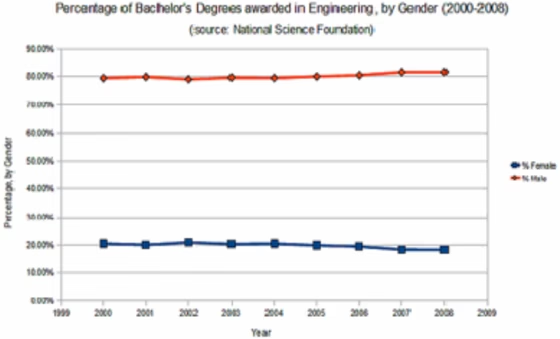
Now I watch my daughter, who also seems to share the uncertainty that I once felt, embarking on a similar academic journey. Even so, I hear of fewer and fewer young women wanting to enter engineering as a career. I would have never dreamed thirty years ago, when I felt the doors open up so promisingly, that women would not be entering the field today. The graph below displays this static fact – and keep in mind, this is degrees awarded. I see many women drop out of the field after graduating.
For more details on the grim numbers, read this blog post with data from the NFS: https://blog.adafruit.com/2010/11/30/women-in-engineering-the-numbers/
Given these statistics, I decided to interview my daughter on why she chose engineering as her major, at least for now, and her plans to work in the field. We also shared our mutual experiences at MIT by answering the following questions together.
What made of you think of engineering as a career?
| Mari | Chris |
| I was influenced by the fact that you and Dad were engineers. I was unsure what I wanted to major in, but I had always taken lots of math and science classes in high school and enjoyed the content. My college counsellor brought up engineering, and I had exposure, given my parents were both engineers, and the more I thought about it, the more I was interested in it. | A guidance counselor also mentioned it to me. I knew nothing about it, but at the time, I was interested in doing things that were not normal and being a female engineer was unusual, so I wanted to go for it. I enjoyed math and science, so I figured it was a good fit and I learn more about it as I studied in college. |
You are in your first engineering class this term. What is the ratio of M-F?
|
Mari |
Chris |
|
It’s close to ½ and ½ – maybe a few more men. |
My engineering classes were mostly men – maybe a 1:5 ratio at best, and as the classes advanced, there were fewer women. |
Is there a difference between hands-on programming experience between men and women in your classes?
|
Mari |
Chris |
|
I have noticed that among my peers in school, the men have a lot more experience programming. I’ve met only one or two women with a lot of experience. |
In my day, computers and programming were still pretty new, so even some men didn’t have experience, but there were many men who did, and I knew of no women who had experience. I didn’t have experience programming. |
|
I didn’t either before I entered MIT. |
Do you think you will stay as an engineering major?
|
Mari |
Chris |
|
Course VI is one of the harder majors. If it is too difficult and I can’t succeed, I may change majors and later fields. I feel middle-of-the- road now, but the people below me will probably drop out, and then I might be below average. |
I loved all my classes in the first few years, but struggled in my third year. I did not get good advising and took classes in an order where I wasn’t ready for the content yet. When I started taking programming classes, I loved it and gravitated towards that. I did feel isolated but I wasn’t alone. There were other women. |
What about staying in the field after graduation?
|
Mari |
Chris |
|
I think I would like to do consulting, and I’m even considering law. I would like to use my technology. I have familiarity with code and the technical aspects of the industry, but I don’t see myself as a designer. |
I, of course, have stayed in the field, and I really love the work that I do. I am a Software Architect, and while I do some programming, I also analyze features with the business team and decide how a feature will fit into our products. It’s rewarding and challenging work, and I’m very glad I stuck with this career. The experience I have now has paid off. |
Have you noticed any gender discrimination?
|
Mari |
Chris |
|
I don’t feel there are any issues related to gender. |
I certainly feel there are issues in the field related to gender. I think there should be way more women in the field. What about the programming contests at MIT? Aren’t those mostly male? |
|
Yes, you are right. And I just noticed that one of them was with “Pokerbots” – robots that play poker. I don’t play poker. |
I have an idea. Let’s form an all-female programming team next year during the programming contests during IAP (Independent Activities Period in January at MIT). I think alumnae can enter. |
|
That sounds great – let’s do it! |
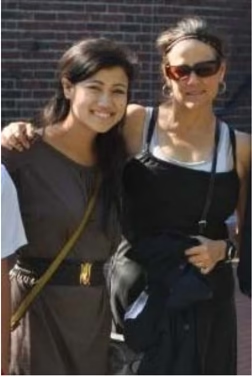 Mari and Chris at MIT in fall 2010
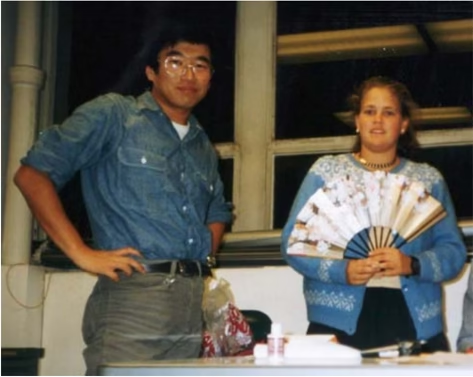 Hiroshi and Chris (before marriage) at MIT in 1985