
How I Survived My First Year in Graduate School
By Melanie Kambadur
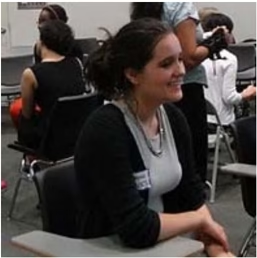
I’d just completed the first year of my PhD studies in computer science, and although it was a challenge to adjust to the changes, it was one of my most exciting years yet. Like many beginning PhD students, I moved to a new university in a new town, picked an advisor and familiarized myself with a new department, made new friends, and began researching. For students who are curious about what the first year of a PhD program is like, I wanted to share my experiences and some tips from this past year.
Settling into a new campus and a new place
I finished my Bachelor’s degree in computer science last spring at Indiana University in Bloomington and started my computer science PhD a few short months later at Columbia University in New York City. Moving from a small college town (and my hometown) to a big city was a huge adjustment for me – I had to get used to public transportation, insanely high rent, and tons of crowds. The move was only the first of many changes, though, because after finding a home and figuring out how to navigate around the city and my new campus, I also had to acclimate myself to a new department. This meant meeting new staff and getting to know the faculty. It also meant re-learning everything from where the coffee and bathrooms were located, to which printers I could use and which places were the best spots to take a nap or hold a meeting.
Getting to work
After I got used to my new home, I had to get used to a new work schedule. As an undergraduate or Masters student, most students spend the majority of their academic time focused on classes and homework. As a PhD student, the expectation is that you will spend much of your time researching. I spent a little time during my undergraduate years on research, but not nearly as much as the minimum 50% required by my new computer science department. The 50% requirement did not sound difficult to me when I first started the school year, but it didn’t take long for me to discover that there would be more distractions than I originally expected. First, there are still classes. It is pretty standard that PhD students take at least two classes for their first few semesters. This might sound trivial, but graduate classes are usually fairly time-intensive, and there is an extra element of pressure for PhD students because of the expectation to earn high grades; at Columbia, for example, we need a B+ or better for credits to be counted. Classes were only one of many distractions that I encountered, though: I also had a few semester-end comprehensive exams on core computer science topics to prepare for, and after only a couple of weeks on campus, I found my calendar filling up with countless appointments. Between class lectures, lab meetings, technical talks, reading groups, class study groups, appointments with professors, and club meetings, there were days when I barely had any time for research.
As an added challenge, I had to pick a research advisor this year. Choosing an advisor was complicated because I had to consider professors’ research interests, their experience, how often they were available and willing to meet with students, their funding resources, and many other factors. I thought about many of these factors before even choosing a graduate school, but I still found myself with four potential advisors when I arrived at Columbia. Since all four had many of the qualities I was looking for in an advisor, I had an especially difficult time choosing whom to work with. I tried to talk to and spend as much time as possible with each of the professors in my first semester. Ultimately, I chose to work with a fairly new professor, Martha Kim. I chose her in part because of her enthusiasm and also because I felt very comfortable discussing my ideas with her. I think she will be a great mentor!
Not all schools emphasize research so heavily in the first year of a PhD, but despite the other commitments, I was actually happy to jump immediately into research – it’s why I wanted to do a PhD in the first place. If you haven’t done any research before, you can expect to spend a lot of time reading papers, discussing and thinking about ideas, and learning and experimenting with new tools or languages. You may be spending a lot less time writing code than you might have guessed. Even though I had done research before, I was still surprised by some things as I began researching for my PhD. One difference was that professors didn’t know what to expect in terms of my education and technical experience. This is because PhD students come from such a wide range of backgrounds; some have worked, some have already completed a master’s degree, and some, like me, have come straight from their undergraduate degree. It was easy to tell professors when I knew more than they guessed, but a lot harder to admit when I didn’t know something they thought I knew. It was worth the mild embarrassment, though; every time I admitted to not knowing something, I got the opportunity and the time to learn something new.
Another surprise was the amount of respect I got from faculty as a PhD student. I was well-treated as an undergraduate, but it has been fun to become a colleague of my professors. As an undergraduate, you are often seen as someone who needs help, but faculty-graduate student relationships are more mutually beneficial. Finally, I was surprised by how difficult it can be to measure progress in research. As an undergraduate, I got a lot of feedback from assignment grades and exams, but as a beginning PhD student, I have had trouble gauging how I am doing. I learned to get frequent performance evaluations, even if I had to ask for them. It was a little scary to ask professors what they thought of my work, but I figured it was way better to hear early on that I needed to work harder than to hear at the end of the semester that I didn’t perform up to expectations. My intuition about checking in early and often was correct; I now know more than one student who has quit their PhD after receiving upsetting end-of-the-semester feedback from their advisor.
Building a life outside of school
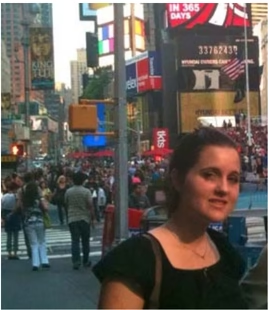
I have heard time and again that a PhD is a marathon, not a sprint, and I can already see the wisdom in that advice. All the new work and expectations make it easy to let academics dominate your life, and can tempt you to overwork. That’s not to say hard work isn’t necessary; most PhD students I know work significantly more than a 40-hour work week, and I have certainly worked more hours in the last year than any other year of my life. The trick is not to work to the exclusion of all else, because you want to be able to maintain your work schedule throughout all the years of your PhD. Also, for me, working more hours does not always mean I get more work done. For example, when I make time to exercise and sleep well, I find that my productivity goes up because being healthy makes me work more efficiently throughout the day.
Making time for a social life has been important for me this year as well, because a PhD is a long-term commitment. I am investing five or six years of my youth in a PhD, and I don’t want to give up all the fun. Moreover, I know that having friends means I will have emotional support in difficult times. I left behind most of my friends when I left my undergraduate school, and I thought it might be hard to make new ones. While I certainly have not replaced my best friends yet, being at a university has made it easy to meet new people. I got to know some of the other PhD students in my department, and it has been a big relief to have people to talk to who understand the situations I am going through. Computer Science PhD students are a fairly diverse crowd, probably more so than most undergraduate computer science student bodies. As a result, I have had a lot of fun meeting more international computer scientists and more women computer scientists this year, particularly through our Women In Computer Science group. I have also had the opportunity to meet a lot of non-computer scientists and non-PhD students through university clubs and activities. In this respect, I feel lucky to be doing a PhD. If I went straight into the workforce, I suspect I would have had a much more difficult time making new acquaintances.
Looking ahead
Hopefully, nothing I’ve shared has scared anyone out of starting a PhD program. Although I admit that this year was a difficult one, I am very positive about the rest of my studies, and definitely happy about my choice to pursue the degree. I have loved having the opportunity to meet new people and learn new things, and I am excited about the new ideas I am starting to develop. I can’t tell you for sure until I’ve graduated, but from my experiences so far, I expect that my years as a PhD student will be very rewarding.