
Reflecting on Communications and Looking Ahead
An interview with Cigdem Sengul
By Adriana Wilde
This month, we say goodbye to Cigdem Sengul in her role of ACM-W Communications Co-chair, as she completes her second full term in this role. In this interview, she reflects on her time with ACM-W and shares some of the lessons she will take into the next chapter of her professional service.
Adriana: You have been involved with ACM-W for many years, including serving as Communications Co-Chair for two terms. What first brought you to ACM-W, and what has motivated you to continue contributing to the community?
Cigdem: What brought me to ACM-W was a remarkable woman — Reyyan Ayfer. I kept coming across her work and reading her articles; I was simply delighted to see another Turkish woman in computing. So one day, back in 2014, when I saw a call for volunteers for ACM-W Europe, I emailed to say I’d like to be considered. I recently read that “confidence is overrated; find courage instead” (as told by Sharon Moore MBE in her keynote at the 2025 BCS Lovelace Colloquium). That was my moment of courage — it was a leap of faith, answering a call without knowing much about what I was getting into. I hope I can inspire other women to join ACM-W committees, just as Reyyan “Hoca” inspired me.
That was the beginning of my transformational journey. That year, I started working in the ACM-W Europe communications team led by Bev Bachmayer, editing and laying out articles for our newsletter. Along the way, I was privileged to work with several regional and global chairs — Reyyan Ayfer, Natasa Milic-Frayling, Ruth Lennon, Bushra Anjum, and Rukiye Altin.
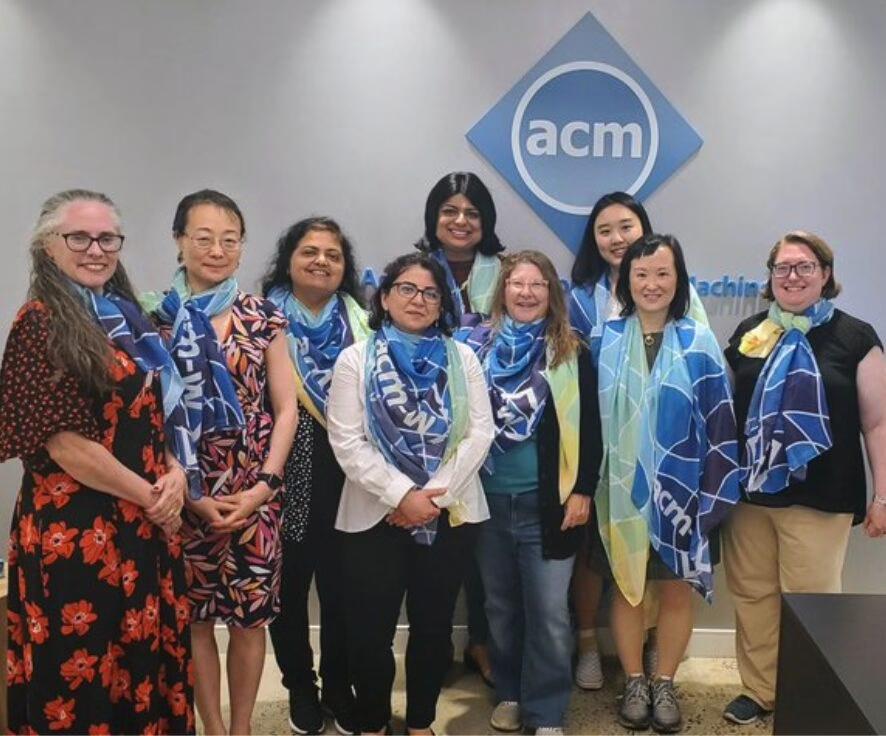
What kept me involved was the way ACM-W invested in me. After taking maternity leave, I was welcomed back warmly and later trusted to lead the European Communications team. Being remembered, supported, and recognised for my leadership potential mattered deeply to me. The encouragement I received from Reyyan, Bev, and Ruth eventually gave me the confidence to apply for the ACM-W Global Communications Chair role when my four years in Europe ended.
I’m now finishing another four-year tenure on the Global team. For the first time, I’m moving into a non-communications role: Community Programs chair, a newly established role overseeing chapters and celebrations. I’m excited!
As for motivation, I volunteer for ACM-W because it’s a nurturing global community: open to ideas, generous with room for volunteers to lead their own projects, and always making space to share challenges, advocate for causes, and celebrate successes. I once read that everyone needs six kinds of friends: the “cheerleader” who advocates for you, the “challenger” who holds you to account, the “counsel” who brings clarity and perspective, the “inspiration” who pushes you to be better, the “light” who lifts every room, and the “safe space” where you can be completely yourself. The ACM-W community has been all of these for me, and I’ve tried to be them in return for the volunteers working alongside me. I need no other motivation than that sense of connection and belonging.
Adriana: Looking back on your time as Communications Co-Chair, what moments, initiatives or changes are you most proud of?
Cigdem: What I am proudest of is helping to build a communications system that is both consistent and sustainable. When I joined Bettina Bair in leading Global Communications in 2022, we were unsure whether we could maintain a monthly newsletter. Four years later, each issue features four to six news items, including regular series highlighting chapters, celebrations, ACM-W scholars, and ACM Fellows. Stories published through U-RISE, Above and Beyond, and Voices of ACM-W celebrate people whose contributions often go unrecognised.
Our social media growth has been equally rewarding. Instagram grew from 200 followers to more than 800, while LinkedIn expanded from 124 followers in 2022 to more than 3,500 in 2026. Asegul “Ace” Hulus has played an important role in making our social media presence livelier and more visually engaging.
The initiatives that matter most to me are those that have continued beyond the initial excitement. Our Wikipedia campaign in ACM-W Europe, launched for International Women’s Day in 2020, is still developing six years later through the womENcourage workshops.
I am equally proud to see volunteers grow into leaders. For example, Alexandra Dediu, who first served as a website manager on the Communications team, became the ACM-W Europe Communications Chair and is now the ACM-W Europe Vice Chair. Adriana, seeing your own journey from ACM-W scholar to my co-chair after Bettina stepped down has been another great example.
Adriana: ACM-W is a global community spanning different regions, cultures and career stages. What have you learned about communicating effectively and inclusively across such a diverse community?
Cigdem: The principle that has held across every team is simple: listen before speaking, and do not assume that one region’s way of communicating is universal. ACM-W includes people at different career stages, working in different languages, cultures, institutions, and technological contexts. Inclusive communication therefore requires curiosity, flexibility, and attention to which voices may still be missing or unheard, ensuring everyone feels respected and valued.
I have learned that inclusion is not achieved simply by disseminating the same message across several channels. It also means varying the format, inviting people to speak in their own voices, making space for regional priorities, and recognising that some contributors may need more encouragement or editorial support than others.
This year, the Voices of ACM-W podcast has given me a direct route to that listening. For example, my first guest, Audrey Mbogho, reflected on the sustainability of student and professional chapters and how they can benefit each other. That conversation planted the idea of bringing chapters closer together through shared or connected leadership. I hope to explore that in my new role. Good communication does more than tell people what an organisation is doing; it helps the organisation listen, learn, and change.
Adriana: During your time leading the Communications team, how have you seen ACM-W’s approach to sharing stories, celebrating achievements and engaging members evolve?
Cigdem: What stands out most to me is how many more channels we’ve opened for community voices to be heard. When I started, we published far fewer personal stories, and the ones we did mostly lived in the newsletter, written by a small team. Today, ACM-W members contribute through blogs, interviews, social posts, reels, videos, podcasts, and the newsletter. Adriana, your own interviews have been an important part of opening that space to more voices.
That shift in our channels has gone hand in hand with a shift in ownership. Our newer editors, Fawzia Kara-Isitt and Jessica Yauney, lead their projects end-to-end, from reaching out to guests to producing the final story. Our web editor, Bethany Ahluwalia, has developed deep expertise in managing our website and now influences how we organise and preserve our content. Bringing our archival newsletters into a more accessible format was part of that development. It gave us greater continuity and helped connect ACM-W’s history with its current work.
Seeing volunteers develop confidence, expertise, and ownership has been one of the greatest joys of leading the team.
Adriana: As the Communications Committee moves to a new Chair and Vice-Chair leadership model, what advice would you share with the next generation of ACM-W communications leaders and volunteers?
Cigdem: The Communications team spans everything from hands-on content creation for our newsletter, social media, and website to strategic work such as building a long-term global communications strategy and setting standards for regional teams. It is easy to become consumed by immediate tasks, so leaders need to keep asking what will best serve the community.
The new Chair and Vice-Chair model creates an opportunity for complementary leadership. No one person will be an expert in strategy, storytelling, design, platforms, analytics, volunteer management, and technical delivery. The strength of the team will come from combining different skills and trusting volunteers to take meaningful ownership.
Skills-based volunteering builds a culture of collaboration and learning. Approach the role with curiosity and a willingness to contribute, and you will find people ready to help. You’ll also find real fulfilment in using your own professional skills, teaching others, or picking up new ones for a good cause. The experience is truly enriching: your contribution genuinely shapes the organisation’s growth.
Things will feel unfamiliar at first, sometimes overwhelming, and they will not always go your way. Embrace being a learner and stay flexible—even when the website goes down at midnight, or you find yourself untangling a WordPress site’s PHP backend. Every challenge is an opportunity to learn something new. Be as patient with yourself as you are with everyone else.
“Things will feel unfamiliar at first, sometimes overwhelming, and they will not always go your way. Embrace being a learner and stay flexible” — Cigdem Sengul
Adriana: Although you are moving into a new role within ACM-W, you will continue to be part of this community. What are you most looking forward to in your next chapter of ACM-W service?
Cigdem: What draws me to this role is right there in the name: community. I’ve spent years amplifying community voices through Communications; now I have the opportunity to help those communities build stronger relationships with one another.
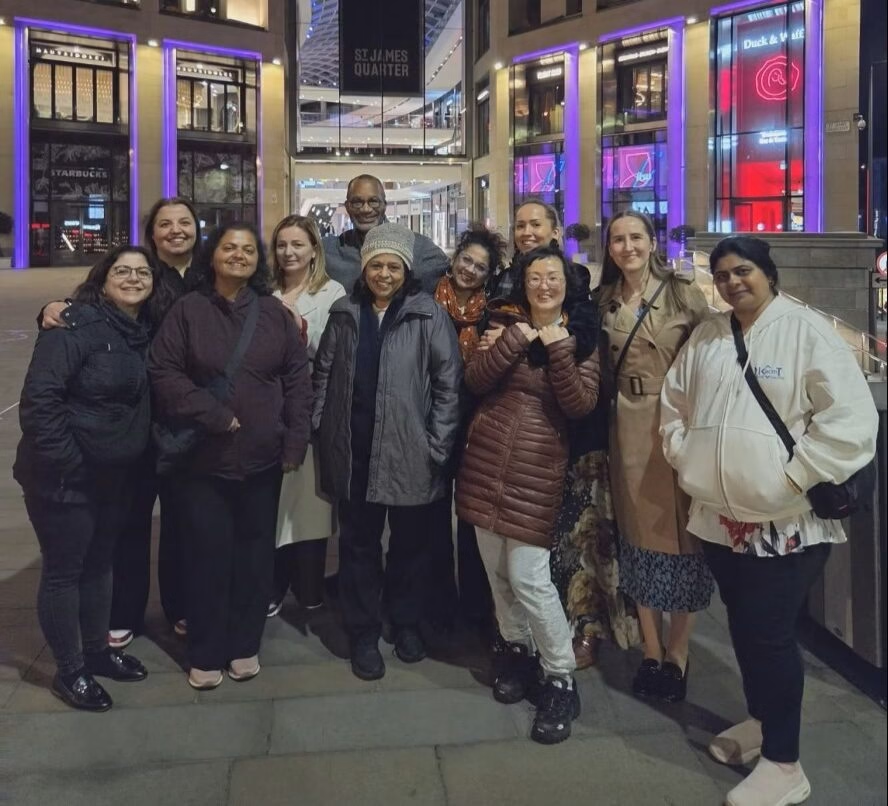
ACM-W has developed a strong global network of chapters, thanks in large part to the Chapters Committee, led by Bettina Bair and our regional teams. Our celebrations are well established worldwide. I would like to help make that growth more sustainable by strengthening processes, sharing practical models, and creating more opportunities for chapters and celebrations to learn from one another. That includes building on initiatives like Arati Dixit’s Buddy Project by developing the structures that could help more chapters participate consistently.
Chapters and celebrations often begin with great energy; the challenge is helping them maintain momentum, exchange knowledge, and remain connected to the wider network. Ultimately, I want every chapter and celebration to feel less like an island and more like part of an interconnected community, supported by the Global team. In Communications, my job was to help our community tell its stories. In Community Programs, I hope to help people find one another, work together, and build a lasting sense of belonging.
Adriana: And I hope so too! Thank you so much for showing me the ropes to my role, and for your kindness always. May I also thank you on behalf of ACM-W for your service and for the many initiatives you have supported, including your next endeavours, for which we wish you the best of luck.