
Goodbye to Lindsay!
ACM-W North America Chair
This month, we also say goodbye to Lindsay Jamieson, ACM-W North America Chair, as she has already completed her second two-year term. In this interview with Jessica Yauney, Content Editor from the ACM-W Communications team, she reflects on her time with ACM-W and shares some of the lessons she will take into the next chapter of her professional service.
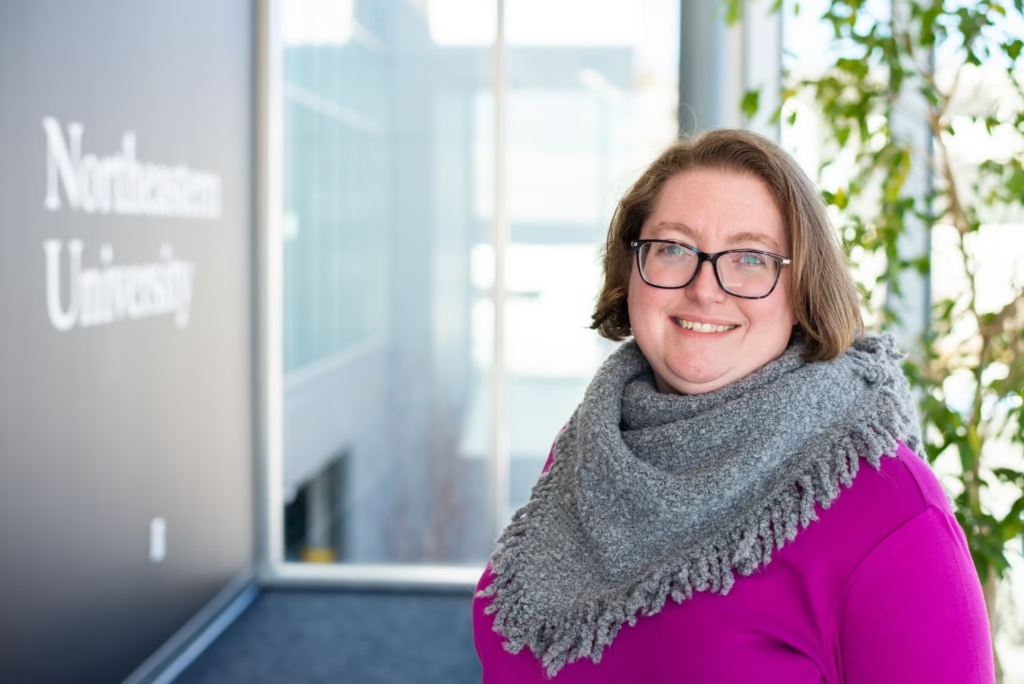
Lindsay Jamieson is a Full Teaching Professor and Associate Dean of Teaching Faculty at Khoury College in Northeastern University. She’s located in Scarborough, Maine in the US. She’s married with two daughters and two cats. Her PhD is from Clemson University and she has a Bachelor’s degree in Computer Science and Mathematics from DePauw University.
Jessica: What first drew you to ACM-W?
Lindsay: I first joined ACM-W as an undergraduate student. It was a great way to find other women in the Computer Science program at a time when I was consistently the only woman in the class. When I started my PhD, I then went on to help starting an ACM chapter at Clemson in order to have a student organization on campus. Later, when I started my first tenure track job, I met up with my mentor from my undergrad, Dr. Gloria Childress Townsend (author of the book Rendering History: The Women of ACM-W) and she invited me to begin volunteering within ACM-W.
Jessica: What inspired you to take on a leadership role?
Lindsay: When the ACM-W North America region was established in 2019, I was excited at the prospect of moving my volunteering from the global ACM-W committee to the new regional structure, taking on responsibility for the Student Chapters Committee. In 2021, when the Chair position became unexpectedly available, I stepped into the role.
Jessica: When you began your term, what priorities or goals did you hope to advance?
Lindsay: When I began my term, the committee was very new and we were all coming out of the COVID pandemic. This meant that my big priority was making sure that we had a team that worked well together and that we had plans in place for transitions between leadership in the future.
My big priority was making sure that we had a team that worked well together and that we had plans in place for transitions — Lindsay Jamieson
Jessica: Which accomplishments from your time as an ACM-W leader are you most proud of, and why?
Lindsay: I’m very proud that we had a student volunteer who completed her studies and then moved into a professional volunteer position to continue and expand her work. I’ve also been very happy with the volunteers that have been added to the committee over the past two years. We’ve been able to add on volunteers from across North America and they have brought their own interests and focus to the roles that they have taken on.
Jessica: Did anything about the role surprise you once you began serving in it?
Lindsay: I was struck by the wide range of experiences that volunteers from different parts of the world shared regarding inclusion and equity. Although we were all working towards the same goals, the challenges we faced often differed considerably depending on local cultural, institutional, and societal contexts. These differences occasionally led to misunderstandings or differing expectations, but they also provided valuable opportunities to learn from one another. They broadened my understanding of how inclusion and equity are experienced in practice and reinforced the importance of listening to diverse perspectives when working in an international community.
Jessica: Where do you believe the computing community still has the most work to do to achieve meaningful inclusion and equity?
Lindsay: Although the number of women in computing has increased, representation is not evenly distributed across different communities. In many countries, women from ethnic or other underrepresented groups remain less likely to enter or remain in computing. At the same time, the discipline continues to address barriers to accessibility, both in the design and use of computing technologies and in creating an environment that is inclusive of people with a wide range of accessibility needs and gender identities.
Jessica: Who were some of the people or groups whose contributions were especially important during your term?
Lindsay: I was very grateful for the support and encouragement of Dr. Jodi Tims, Dr. Monica McGill and Dr. Nicki Washington as I took over the leadership of ACM-W North America. My term would not have been as successful without the wonderful women on my team.
Jessica: What advice would you give to someone considering volunteering for ACM-W or taking on a leadership position?
Lindsay: Volunteering for ACM-W can be a very rewarding experience and I encourage anyone to reach out to their local ACM-W chapter to join and find out what’s going on. If you don’t find a local chapter, consider creating one. We have a great team that can help you be successful in creating a chapter and making connections with women in computing. The women that I’ve worked with in ACM-W are ones that I know I can reach out to and connect with even though we may have left the roles we were in originally.
If you don’t find a local chapter, consider creating one. We have a great team that can help you be successful in creating a chapter and making connections with women in computing. — Lindsay Jamieson
Jessica: As you conclude your term, what message would you most like to leave with the ACM-W community?
Lindsay: Having diversity in computing is really important and being able to support others who are expanding the diversity in the computing fields can be one of the most rewarding parts of your career. As a part of ACM-W, you are helping us to create better, more accessible computing for all those who come next.