
A Fork and a Join: Career, Family and the Virtual office
by Kamna Malik
Introduction
It was with a mix of conviction and numbness that I walked into my boss’ office in the summer of 2007 and announced my decision to leave my workplace after fourteen performance-packed years at one of the top 10 business schools (b-schools) in India within my geographical area. I had accepted an offer to join an online b-school and operate from a virtual home office. At the time, this decision was entirely professionally motivated, but as I reflect over the past few years, I realize that the move to a virtual office has been a blissful “join” of the “fork” between career and family that I had previously accepted as an integral part of my life. This join has elevated me to a new normal.
The Fork of Life
The term “virtual office” is said to have originated in 1983, but it appeared on my radar about 18 years ago as a wishful and persistent thought that occurred to me after I became a mother. Every time it popped up, I’d shrug it off and carry on with my struggle to nurture the growth of my career along with my family. The rise of the personal computer in the 1990s and the subsequent Internet revolution changed our daily lives. Although the idea of a virtual office was no longer a futuristic concept, organizations still had a long way to go to incorporate flexibility and family friendliness into their work cultures.
I was young, enthusiastic, and ready to take the bull by the horns. Having topped the masters’s class and secured one of the highest-paid jobs in a class with just 10% women, belonging to a minority never seemed like a constraint. Life was good, with higher job responsibilities and promotions coming my way sooner than expected.
I was reporting to and competing with male colleagues whose wives were mostly homemakers – by choice or by force. Many of my female friends had either sacrificed their marriage or their career in an attempt to save the other. With time and job responsibilities, my family pressures started to mount, owing to social, biological, and historical reasons. I found myself assuming the role of caretaker for everyone in my family, trying to live up to the tradition of the iconic Indian lady who is a symbol of love, care and sacrifice. Contrary to my expectations, the pressures only multiplied with time as growing kids and ageing parents needed more attention, and so did the increasing responsibilities at work. Career and family looked like a fork with ever-growing and divergent prongs that never seemed to meet. I started to feel the pinch of gender inequality, but because of my passion for computing and belief in women’s liberation, I kept going. Deep within, I had accepted my life as is – as an ever-expanding fork.
Calculated Risk
When I received the virtual job offer, I was in a quandary. It was a tough decision as it meant relinquishing the comfort, recognition, and power, as well as the emotional bonds, that I’d built over the years, but the excitement of exploring a new world was tempting. The time was ripe, with the growth of the social web, virtual worlds and eLearning. If, as an IT professional and educator, I could not take this plunge, who could? If I did not step forward now, age might catch up with me and I might miss the train altogether.
Working from a virtual office and e-learning are still not mainstream, especially not in my country. Nevertheless, my long-cherished dream and the opportunities presented by my new employer gave me courage, and I plunged ahead.
Initial Shocks
Handling office chores was not an issue as my teaching responsibilities, academic roles, and institutional processes functioned much the same. I was able to start working from my virtual office soon after the orientation week. My time was now for my work alone. The morning blues and the traffic snarls were out of my life.
However, then came the social shocks. Some of my prior colleagues inquired if I had differences with the management or succumbed to family pressures. Neighbours assumed that I had quit working because my car remained in my driveway. Relatives wondered if I was really drawing a paycheck. Everyone in my family assumed I was now fully at their service and that I had magical powers for context switching. It took me some days to absorb all this, but most of these shocks settled down within a month. There was no use justifying my position or decision to anyone, as I was clear on my goals. Instead, I focused on following rigid work hours to avoid getting trapped in domestic duties. I had to prove myself in a totally new context.
Intermittent Issues and Conflicts
My time was my own—no commuting, no pop-in visitors, no coffee meetings, no walk-in booksellers, and no compulsory teaching hours. The learning curve became steeper as I started digging deeper into the online world of business and education—a world that I had largely ignored in the day-to-day of the brick-and-mortar environment, which was (and still is) much lower on the e-readiness meter.
My physical fatigue subsided. My legs and my voice were unstrained now as my teaching duties transitioned from classroom-based lecturing to asynchronous online facilitation. But it did not take long before the fatigue manifested itself in my eyes, neck, back and wrists. I added some rotary exercises and walks to my daily routine to counteract the health hazards of excessive sitting and computer use.
The more time I spent on my computer, the more I felt disconnected from the physical world. The physical meetings were reduced, as my new employer, colleagues, and students all resided in different time zones. There were moments when long sessions on the computer put me into a low or silent mode. I missed the smiles and the greetings I often received from students and colleagues as I passed through the corridors. Many people around me still did not understand how a virtual office or company worked. A fear of loss of social power and identity had started to seep into my consciousness.
My spiritual powers came to my rescue this time. I restored my belief in myself, drove out the thoughts of pseudo power, and reminded myself that my work is real and that the respect and identity that are sustained are linked to my professional excellence. I joined the local professional chapter and also started accepting select invitations for guest talks and consulting in the region. Though an expected norm for an academic, such tasks were earlier too much of a struggle. Today, they are welcome opportunities that help me balance my physical and virtual abilities. They also give me a chance to motivate others to consider the potential of the virtual office for them.
Another jolt was when I discovered that I had to handle my income tax and other legal employment matters on my own because my employer was in another country and jurisdiction. My scope of self-services was extended, but it was a good bargain.
Sustained Advantage
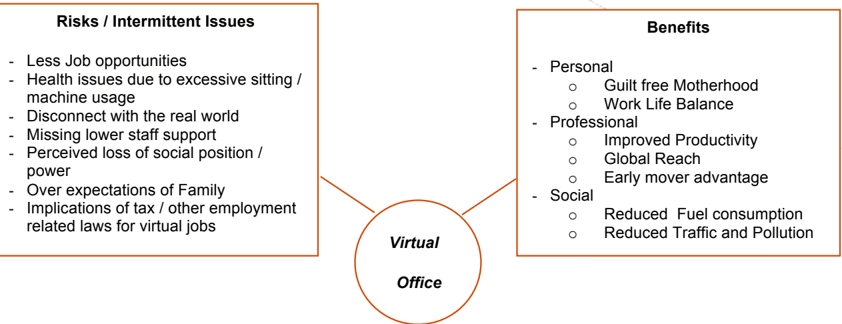
Luckily, most of the conflicts I encountered were manageable, and with each resolution, I realised the increasing personal, professional, and social advantages that a virtual office brought. (For a quick overview, see Figure 1: Pros and Cons of the Virtual Office.)
The pseudo flexibility I’d experienced in my earlier job was replaced with real flexibility. Earlier, flexibility meant a bit of relaxation during work hours, but there was no concept of spatial flexibility. Now I can attend meetings and class discussions even while on the road or out of the country. My office runs uninterrupted, even during difficult times when I’ve attended to an ailing family member.
Earlier, I could not consider leaving my home for an international assignment, which is an important aspect of career growth. Now, I participate in the global, multi-cultural community on an ongoing basis, without the guilt of leaving my family or country.
The near elimination of overheads such as physical fatigue, morning blues, and work-home role conflicts leaves me with much more time and energy to do consulting work, join social clubs, attend family gatherings and also pursue my hobbies. I spend more time reading and writing. I have actually become more punctual, organized, multi-faceted and social. Not to forget, the virtual office is still a “new age” work model and I am excited to be an early bird, navigating new horizons and contributing my bit to technology adoption as well as saving fuel while avoiding traffic jams and pollution.
To quote Arnold Toynbee, “the supreme accomplishment is to blur the line between work and play.” A virtual office is a sure catalyst towards this accomplishment. I encourage more people and more policymakers to experience and facilitate this model if they are truly serious about increasing productivity and work-life balance.
Ways to Manage
- Fix your targets, time and place of work
- Develop self-service habits
- Differentiate SOS from routine domestic calls
- Explore the potential of virtual teams in your line of business
- Check the authenticity of your virtual employer
- Join professional virtual as well as physical/local networks
## About the Author

Kamna Malik, PhD, is currently Associate Dean, Research and Discipline Chair of Software Systems and Strategy at GlobalNxt University, Malaysia. She started her career with software development and gradually migrated to face-to-face and then to online management education. Over a span of 23 years, she has worked with some of the leading organizations and bschools in the region and has managed diverse functions and initiatives spanning practice, education, research, publications and consulting. Her broad teaching and research focus lies in enabling better use of IT for improved business value. She lives in India with her husband, two daughters and parents-in-law.