
Finding a Great Summer Research Experience for Undergraduates (REU)
by Suzanna E. Schmeelk
Introduction
Finding a great summer Research Experience for Undergraduates (REU) is a recommended component for a successful and satisfying graduate school transition. REUs are important, according to the National Science Foundation, as they can support “developing a diverse, internationally competitive, and globally engaged science and engineering workforce.” There are many technology-based research experiences for undergraduates throughout the country – try a search engine. One of the best pieces of advice I would like to suggest is to seek a research experience at a university that you would like to attend. The experience will introduce you to the faculty and resources that the school will provide if you decide to attend. In fact, the experience may sway you, the undergraduate, in a particular direction about attending the particular university for graduate school.
The Research Experience
The research experience can be of many forms. A REU provides an environment for an undergraduate to perform research in a scientific field of interest. Qualifications that a student should have can vary; but, usually, a student is pursuing a degree in the field or closely related field. The REU is usually two months, finishing with a talk, paper and/or poster for presentation. Projects and personal guidance are highly dependent on the program and mentors. This is why I suggest researching a university’s research environment prior to graduate enrollment.
TRUST
For example, I recently helped lead an underrepresented group-oriented REU at the University of California, Berkeley, at the TRUST Centre. TRUST, The Team for Ubiquitous Secure Technology, has an amazing program. The program had many components, including meetings with world-renowned faculty and industry leaders, regular cybersecurity (technology) lectures and informative lectures pertaining to both graduate school and the formal research process. If you look at REUs, try to find one with (at least) matching topics.
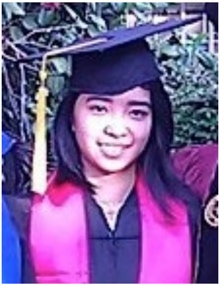
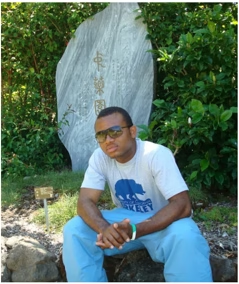
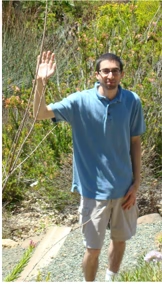
TRUST REU 2010
To offer you an example of how REUs might be structured, we structured the TRUST REU interactions at many levels. First, we met with the entire REU-body as we confer with the ISI at USC. Second, we divided the students into teams where each team had their own personal research questions and weekly meetings. Finally, we had small individual meetings to help students with their own personal research. TRUST is somewhat unusual as it is NSF-funded and encompasses multiple universities. As such, other REUs may not have the resources available to provide multi-level interactions.
As for living, the TRUST program provided housing, stipends and laptops. TRUST treats REU students to many graduate-student benefits such as the library, health center and computer-lab access. Try to find an REU that will help ease your transition to a new and temporary location with such amenities.
About the Author

Dr. Suzanna Schmeelk is a Network Security Research Scientist at LGS Innovations Ñ Bell Labs in New Jersey. She completed a New York State Certificate in Cyber Security at the Polytechnic Institute of New York University in December 2012 and a M.S. in Technology Management in 2013. She is Alcatel-Lucent NRS1 routing certified and has a doctoral degree in Mathematics Education from Rutgers University. Additionally, she holds MS/BS degrees in computer science. She is currently authoring several papers, journal articles and book chapters, which will be available in 2013 and beyond.