
ACM-W Above and Beyond: Mansi Agarwal’s Journey
By Jessica Yauney
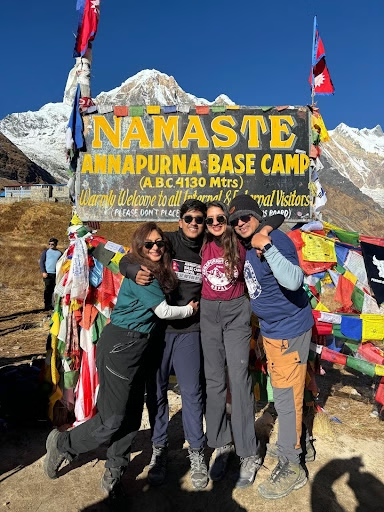
As part of the ACM-W Above and Beyond Project, we are excited to feature Mansi Agarwal, who works at the intersection of computer vision, multimodal AI, and robotics. At Amazon, she led the end-to-end development and calibration of a large-scale multi-sensor AI system deployed across hundreds of stations. She’s deeply passionate about embodied AI, real-world deployment, and building systems that push the boundaries of perception and manipulation. Outside of work, she loves traveling, exploring oceans, and petting every dog and cat she meets. She’s also a national-level swimmer, a trained Kathak dancer, and an avid reader. She brings the same dedication and discipline from these pursuits to her work in AI and robotics.
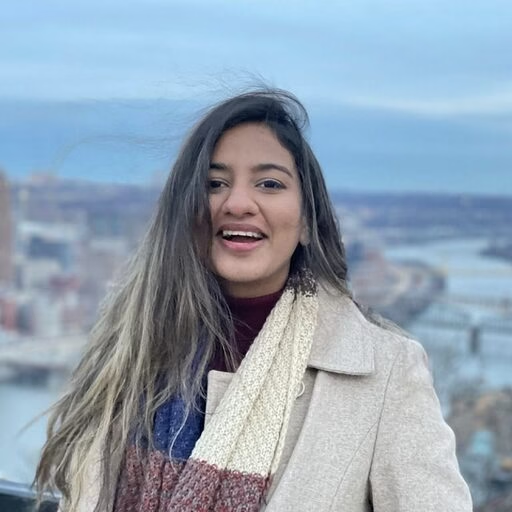
Current role, organization: Applied Scientist at Amazon Robotics
Year of Scholarship and Conference Attendance: AAAI 2020
Country of Origin: India
Country of residence at the time of receiving ACM-W Scholarship: India
What has been a highlight of attending the conference?
A major highlight was the opportunity to meet researchers and engineers working on cutting-edge problems in computer vision and robotics. Being an ACM-W Scholar gave me the confidence to approach labs I admired, ask deeper questions, and genuinely feel part of the broader research community. It was also the first time I saw such a diverse, global group of women excelling in fields I aspired to join – it was incredibly empowering.
How did attending the ACM-W-sponsored conference impact your career? Did it lead to any important connections in your field?
Absolutely. The scholarship directly opened doors for me. I connected with mentors who later guided my graduate school decisions and research direction. Several conversations at the conference informed the trajectory of my Master’s research at CMU and eventually helped me transition into robotics roles in industry. It was also the first time I felt represented in the research community, and that sense of belonging played a big role in my confidence to pursue ambitious projects.
What has been your career highlight? What are you most proud of?
My biggest career highlight has been leading the development and large-scale deployment of the ARID-Depth system at Amazon Robotics – a multimodal AI system for item identification integrated across 700+ robotic stations. The work involved research, engineering, calibration, modeling, and cross-team leadership, and it ultimately contributed to a 0.66s LC5+ pick-time reduction and has a global potential of more than $100M in annual savings.
I’m also proud of my research background. At Carnegie Mellon University, my research focused on robotic cloth manipulation using reinforcement learning and point-cloud reasoning. It led to multiple peer-reviewed publications, a patent, and contributions to reinforcement learning and embodied AI.
What aspects of your career have you found challenging?
Navigating ambiguity has been both the most challenging and most rewarding part of my career. Many of the problems I work on have no existing playbook. Furthermore, bridging research and deployment requires deep technical rigor and constant iteration. Being an international student on a visa also added an additional layer of pressure to perform and build a strong track record early in my career.
Was the connection to ACM-W helpful or important in any immediate and lasting way?
Yes, ACM-W played a foundational role. The scholarship not only reduced financial barriers but also gave me early validation that I belonged in the research community. It was one of the first recognitions of my potential, and it encouraged me to pursue competitive opportunities, publish more, and push myself academically. The confidence and connections I gained have had a long-lasting impact on my trajectory.
I’m passionate about making robotics and AI more accessible to women entering the field. I regularly mentor students, run user studies and workshops, and speak at events about navigating research careers. Representation matters, and I hope my journey – from a student inspired by an ACM-W scholarship to a scientist deploying real-world AI systems – encourages other young women to pursue robotics fearlessly.
