ACM-W Above and Beyond: Dr. Rosanne English’s Journey
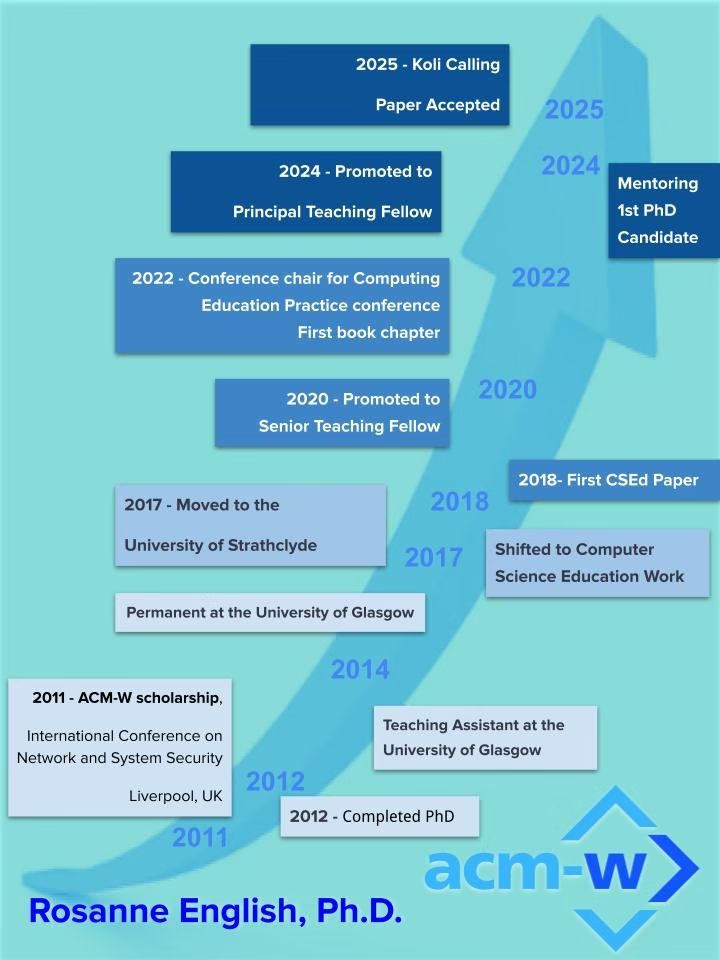
Rosanne English came to her current role through a non-traditional route. Rosanne’s undergraduate degree was in Pure Mathematics at the University of Glasgow. Upon graduation, she began working as an accountant and completed professional qualifications in this before realising it did not align with her goals. Rosanne then decided to take a leap of faith and completed a conversion Masters in Information Technology in 2008/2009, wherein she realised she loved the subject and wanted to learn more. In 2009, Rosanne began a PhD in cybersecurity, and she hasn’t looked back. Her work now sits at the intersection of computing education and cybersecurity education. She earned her PhD in graphical passwords and has since built a career centered on teaching-led scholarship. Since shifting focus to education, Rosanne has published in areas such as designing cybersecurity assessments, active learning techniques, and graduate skills. She is active in the wider ACM community through her work in the computing education community, serving as Vice Chair of UK SIGCSE and has been a reviewer for venues such as Transactions on Computing Education, SIGCSE Technical Symposium, and UKICER.

Current role, organization: Principal Teaching Fellow at the University of Strathclyde
Year of Scholarship and Conference Attendance: Fifth International Conference on Network and System Security, 2011
Country of Origin: Scotland
Country of residence at the time of receiving ACM-W Scholarship: Scotland
What has been a highlight of attending the conference?
Attending the conference through the ACM-W scholarship was an important early milestone for me. It was during the second year of my PhD, and the scholarship enabled me to attend and present at my first international conference. It was one of my first opportunities to present my security research to an unfamiliar audience. I’d actually planned to attend and present at a different conference the year before, but there were snowstorms, and I couldn’t travel, so being able to go the next time around felt like it really mattered.
How did attending the ACM-W-sponsored conference impact your career? Did it lead to any important connections in your field?
In terms of impact, it helped me build the skills and confidence to talk to people I didn’t already know about my work. Even when your career path evolves, those early opportunities to speak with new researchers and be part of a broader community stick with you. It had a lasting effect on how willing I was to show up, speak up, and participate in the wider field later on.

What has been your career highlight? What are you most proud of?
One of the things I’m most proud of is the impact I’ve had through mentoring and supporting students. A highlight for me has been working with a PhD student whose work looks at how to support students with dyslexia to learn programming. Many people hear “dyslexia” and think they understand it in a general sense, but the reality is more nuanced. Seeing her develop, grow in confidence, and progress in that work has been genuinely rewarding.
What aspects of your career have you found challenging?
A big challenge early on was simply figuring out what success looked like once I moved into a teaching-focused academic contract. Teaching-focused roles are becoming more common in the UK, but when I was appointed to that type of position, I was the only one in my department on that kind of contract. For a while, there wasn’t a clear roadmap. It took time to get traction and confidence in that space.
Another challenge was the shift in research culture when moving from my earlier security research into education research. The methods, expectations, and even what “counts” can feel different, and adjusting to that perspective shift was real work.
Was the connection to ACM-W helpful or important in any immediate and lasting way?
Immediately, the ACM-W scholarship directly enabled conference attendance and presenting, and that mattered. It was a concrete door-opener during my PhD, and it helped me build confidence and professional skills I continued to use long after.
Longer term, my ongoing professional-community involvement hasn’t been primarily through ACM-W specifically, but it absolutely echoes the same spirit: I’m now the vice chair of the UK Special Interest Group in Computing Science Education (SIGCSE) at ACM. This connects me with colleagues across computing education and links into the associated conferences we support. That kind of community connection is a lasting part of how I’ve grown professionally.
What advice do you have for people early in their careers?
First: Document your impact as you go. If you’re changing how you teach to help students or building something new, gather evidence as you’re doing it. It’s easy to focus on the work because it feels meaningful (and it is), and only later realize you need proof for promotion cases, papers, or applications. I learned that the hard way, and I still have to remind myself to do it.
Second: Define your “north star.” It’s easy in academia to get pulled into doing things because they sound like what you’re “supposed” to do. But you can spend a lot of time on work that doesn’t create much value for students, your community, or even your own long-term goals. Being clear on what you’re trying to achieve makes it easier to choose opportunities that actually fit your story rather than getting bogged down in obligations that don’t align.