
What Can We Learn From Computer Engineer Barbie?
By Claudia Galván
Where it all started
Growing up, I never played with or owned a Barbie. Like many would-be engineers, I played with Legos. It’s not that I had anything against Barbie – I liked the dresses and the hair – but I always preferred to build things or, even better, understand how things worked. When Barbie Computer Engineer appeared in stores, my curiosity led me to analyze what things Barbie does well that women engineers can learn to help them move up the career ladder.
We are all familiar with the under-representation of female engineers at all levels in the engineering field. Although women today are a majority of those earning bachelor’s degrees, they remain severely underrepresented in leadership roles in engineering and the physical sciences.
The recent December 9, 2011 article by Claire Cain Miller, “Where Are the Women Executives in Silicon Valley?” brought further visibility to this subject:
“Of California’s 400 biggest public companies, technology companies have some of the lowest percentages of women directors and executives, according to the annual Study of California Women Business Leaders. Only 5.2 per cent of directors in the semiconductor sector are women, and just 7.7 per cent have more than one woman director, compared with 40 per cent of companies in all other industries. Just over 9 per cent of directors in the software sector are women.”
These low numbers are partly a reflection of the number of women graduating from technical fields, but also reflect the challenges the few women who are in technology face in getting and maintaining top-level positions. Women in technology often find themselves being the only woman in the room and not fully understanding the playing field. In this article, I provide tools to help women in technology climb the career ladder, based on research from experienced women in technology and my own experience working in Fortune 500 companies and as a VP of Career Guidance for the Society of Women Engineers in Silicon Valley.
When I was a young developer, I remember sitting in my office all day, eating at my desk, and holding meetings in my office. One day, my manager mentioned that I should get out of my office more. At that time, I did not fully grasp the importance of what he was trying to tell me: That to get ahead, you need to be able to network, influence, and have mentors. It was not until I was nominated to an executive program for women that I started to understand that working hard and having technical skills are not enough to move ahead; soft skills like communication and leadership are what will help you get to the next level.
According to the Anita Borg Institute 2008 Research paper by Simard et al: Climbing the Technical Ladder: Obstacles and Solutions for Mid-Level Women in Technology, the top three perceptions of rewarded behaviour among mid-level technical people are: speaking up, self-promotion, and ambition. See figure.
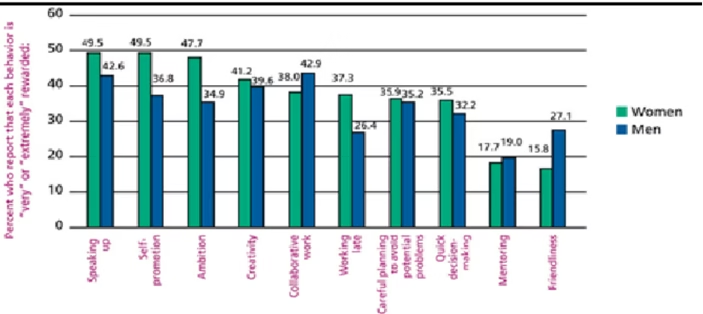
These are exactly the same three characteristics we women shy away from so as to minimize the perception of being “too assertive”.
The answer to this paradox is balance. You can speak up in a timely and credible manner. You can promote yourself in a subtle manner, and you can and should show ambition by asking for what you want.
I truly believe that there is no secret balance at work to ensure one’s success and instead, there are only two routes to go: opportunities to be taken or opportunities to be lost. I always ask myself…. which route do I want to take? Luciana Vecchi, Business Product Manager, Globalization, Adobe Systems
What can we learn from Barbie? Can women in engineering take advantage of some of the soft skills that Barbie is known for? What are the basic tools to help advance women engineers in the workplace?
Barbie, not your typical Role Model
Barbie, with her impossible proportions, has often being criticized for not being a good role model, but girls love to role-play with Barbie: getting her dressed up, taking her places, and playing with her girlfriends. Banking on this, Mattel and the Society of Women Engineers hope the Computer Engineer Barbie generates increased interest among girls in becoming an engineer when they grow up. Only time will tell; however, it is proven that having role models can make a difference in a child’s life and choices.
For now, women engineers are in a unique situation in the workplace. As technical women, they often find themselves being the only woman in the room – this can create a sense of isolation. How can women successfully participate in these all guys’ conversations and join the game?
During their careers, women generally focus on working hard, getting the job done, and being reliable, on top of balancing work and family. With all that work, women in technology shrug at the thought of going to a networking event, or even leaving their office to go for lunch ( ahem ) or taking the time to build relationships. There is already too much on their plate.
This isolation can preclude some technical women from fully understanding the workplace dynamics and expected behaviors, which often can result in getting bypassed for promotions and big projects.
Which behaviors do we need to change to have more control over our careers? I narrowed it down to a few of Barbie’s skills that, as women in technology, we can use:
- Hang out in the game room or Networking 101- We will review some skills to make the best of your time and connections.
- Chat with BFFs or a mentor and be mentored – How do you find a mentor? What does it take to become a mentor? Many women pass up the opportunity to be mentored and to become mentors. We will review the mentoring process and the expectations of the different roles.
- Standing up on your tippy toes without falling, or the Art of Speaking up – Do you find yourself not speaking up or speaking too much? We will discuss how to find the right balance and tone.
- Look and act the part, or Showing your Ambition – Some women engineers struggle with a lack of confidence; we will discuss the tools to show your skills in any situation.
Let’s get started.
Hang out in the Game Room
The Game Room for Barbie is where she hangs out with her friends and establishes relationships. Networking events, especially industry ones, are great places to establish relationships and, yes, expand your network! I have heard every single excuse in the book from my women engineer friends: “I don’t know anybody”, “I don’t drink wine”, “I don’t know how to network”, “I am too busy”, etc.
The truth is that we are afraid of getting out of our comfort zone. Initiating conversations and talking to strangers can be hard work if you do not know how to start. We need to make the time.
Finding a networking event is easy. Search the web for conferences, meet-ups and associations. Many times, you can join mailing lists to get informed of upcoming events, and many of them are free. Once you find the one you are interested in, register and put it on your calendar.
Barbie would bring a BFF or buddy with her, or yes, she would go by herself and run into someone new and start to chit chat (see below). The benefits of going to networking events are getting out of your office, seeing other companies’ campuses, and getting free food and wine. Networking events also host great speakers that you can learn from, and, of course, don’t forget to have fun.
Then, once you decide to go to the networking event, do some prep work.
1) First, be selective in which networking events you are planning to attend and have a game plan. Ask yourself the following questions: Why should I attend this particular networking event? Try to attend conferences and networking events in your industry and professional area at least once a month. This allows you to keep current on topics, meet experts, and expand your network in your industry. You can RSVP on Facebook or LinkedIn so that other people know you are attending.
Who do I want to meet? If you are interested in attending the event because of the speaker, make a point of looking up their bio online so that you can recognize the person and, later on, introduce yourself. If you want to meet other industry experts, make sure you mingle and meet at least one person. After you make this connection, follow up with a personal email.
What can I learn? From speakers, panelists or just attendees, conferences are a great place to hear the latest and greatest in your industry or areas of interest. Who is hiring, who is laying off, and what are the hottest industry trends? Come prepared to share some non-confidential (of course) information. Remember, you are also the spokesperson for your company – represent it well.
2) Bring your business cards. If you forget your business cards, ask for the card of the people you meet to continue the conversation by email, over coffee, and certainly connect on LinkedIn. Make sure to jot down about what you discussed to remember later on who they were later on.
3) Prepare a 30-second elevator pitch about yourself. What do you want to communicate about yourself? And specifically think about how you want to be remembered.
What do you do once you get there?
Plan to go with someone or by yourself. In either case, look around for people you know and say, “hello,” catch up and also go ahead and meet some new people. Start a conversation with people who are standing by themselves by first introducing yourself and your companion. Here are some good openings:
1) Hi, I am <your name here> from <your company name here>. Is this your first time at this event?
2) What brings you here tonight?
3) Provide a sincere compliment or ask a question
Remember the Rule of Three. Whenever you meet someone, try to find 3 things that you share in common… You will find that it really helps in meeting diverse people … and building a great network. – Alex Woody, Senior Manager, Program Management, EFI
Once you have established a connection, use your 30-second elevator pitch. One of the key tips I learned is to close with “Ask me about —–” where you fill in the blank with your area of expertise that you would like to be known for or remembered.
Additional advantages of attending networking events are meeting potential mentors and recruiters. Even though you may not be looking for a job, it is great to have a network of recruiters for when you decide to make a change.
Another way to expand your network inside your company is by joining the Employee Resource Groups (ERGs), also known as Affinity groups, which bring together people with similar interests to discuss common topics, find referrals for local professionals (dentists, etc.), and provide invitations to attend networking events. Some of the best leads for networking events have come from the women’s group I belong to in the company.
Chit Chat
Chit Chat is about getting out of your shell and connecting with others – getting feedback in an informal setting to further expand your network.
Start by connecting with your coworkers first – they are the low hanging fruit. Take fifteen minutes a day to get to know them better in a familiar setting. For example, when getting a coffee, don’t rush back into your office, take the time to “hang out” a few minutes by the coffee machine, do some small talk and get to know the strangers in your hall. Small talk ranges from talking about the weather to asking opening questions like “what group do you work with?” to “how was the traffic?” – anything to break the ice.
You can also use chitchat to influence others. If you are planning to bring a new idea to a meeting, you can ask in an informal setting what someone thinks about your idea. This is a great way to get feedback beforehand and resolve any issues or decide to delay putting your idea forward until it is more fully baked.
Use chitchat before and after meetings. This is a great time to build rapport and strengthen relationships.
Lastly, treat chitchat as Thanksgiving dinner conversation: stay away from religion and politics, do not complain, criticize, or gossip. Listen and share the goodies!
Chat with BFFs
I wish I had known the importance of having a mentor when I was younger. Having a group of mentors has allowed me to get feedback and insights that I would not have had otherwise. You need to decide whether you need a coach, a mentor, or both. A coach gives someone advice to achieve a particular goal: be a better presenter, better manager or executive; manage your career, etc. There are professional coaches you can hire for a fee. With mentors, you can bounce ideas off them to help make important decisions, share experiences and also provide candid feedback on bettering yourself. Mentors are like a board of directors that provides direction and advice on your career. However, beware of having too many mentors, which can lead to inaction.
How do you find a mentor? First, look around you – start with some close friends. They can provide you with candid advice and insight. Then look for people whom you admire. Is there someone super successful whom you wonder, “How does she do it?” Go ahead and ask her to be your mentor. Go to a conference and invite the presenter for coffee. Explain your situation and that you are looking for a mentor to discuss some upcoming decisions and ask if s/he can help or if s/he can recommend someone.
Be open to reaching out to male mentors as well, as my friend Linda Holroyd, 2011 Business Journal’s Woman of Influence, says: “having a man as a mentor is the ‘secret sauce’ to moving to the top.”
Do not discriminate based on age. Mentors do not necessarily have to be “older and wiser,” reach into the younger population for a unique point of view. This is especially important if you are working with or managing Millennials (a.k.a. Generation Y – people born between the late 1980s and early 2000s).
Once you established the mentor connection, set up regular meetings and an agenda. These have to be set up by you, “the mentee,” who will be driving the mentorship relationship. Keep the meetings short and focused, and decide beforehand how long the relationship will last. It may transition into a friendship after your objectives have been met. Also, as needs change, you may need to reevaluate the mentoring relationship and mutually decide to move it in another direction or select a new set of mentors. Always discuss expectations, especially confidentiality agreements.
Never underestimate the value of talking out a work issue with a mentor. Just the process of talking a problem through with someone you trust can give you the perspective you need. Often, the flash of insight you’re seeking will follow. Take the time to find a mentor. – Michaela Guiney, Product Engineering Director, Cadence Design Systems
Mentors can be inside or outside your company and can be in different geographies.
When I first started to work in my last company, it was the first time I worked from a remote site (I always worked in the headquarters). I approached one of the senior directors in EMEA to become my mentor, as I needed to understand from his experience the best way to work with the company’s headquarters. We had video and conference calls, and I felt I gained insight into the company’s distributed development process. For my mentor, the relationship was beneficial because I provided insights into Silicon Valley culture and best practices, a win-win for both of us.
Consider becoming a mentor yourself. At any age, in any stage in your career, you can help others by sharing your experiences and point of view. Being a mentor allows you to learn from others’ experiences and get insight into other organizations. Your role as a mentor is to listen, share your experiences, be candid and tactful, ask questions, and be the cheerleader of your mentee.
Every woman will benefit from becoming a mentor to an up-and-coming woman, be it a junior at work, a college grad, or a high school student. I learn as much from my mentees as I do from my mentors. My mentoring sessions help me reinforce values I believe in and enable me to progress on my path with confidence! – Preethy Padmanabhan BDM, Cisco & (In) Entrepreneur
Standing up on your tippy-toes without falling
When you stand up to speak up, it’s like standing on your tippy toes, you need your balance.
Remember, speaking up is the key perceived rewarded behavior for Mid-Level managers.
Fake it till you make it. Sometimes my legs have shaken under the table in a meeting, but I kept on track with my point. When you first practice being firm, you might come across [as] too strong or weak. Don’t give up. If you’ve not done it before, it takes practice, and doing it is the number one way to learn. I read that women earn less and get fewer promotions because they don’t ask for raises and promotions as much as men. – Natascha Thomson, MarketingXLearator, B2B Marketing/Social Media Consultant
Do you find yourself not speaking up or speaking enough at meetings? Do you find yourself stretched too thin and scattered? Do you ask for what you want? How does Barbie stand on her tippy-toes without falling?
Here are three Golden Rules to follow:
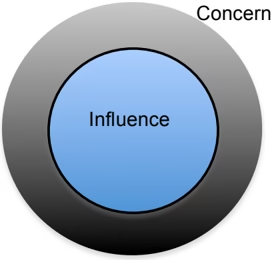
Number 1: Determine ahead of time your circle of influence versus your circle of concern. This is a key skill to keep you focused on your strategy.
What is the difference? Your circle of influence includes areas directly related to your job that will impact you, your team, or your project performance. Your circle of concern includes areas you may be interested in or have some expertise in, but they do not directly impact you, your team, or your project performance. It is surprising how much time and energy we spend on our circle of concern. Choose your battles inside your circle of influence to maximize your credibility and focus.
A key difference between a leader and a follower is the ability to speak up assertively, respectfully and strategically with the intention of forging relationships and creating results. – Linda Holroyd, Founder and CEO, FountainBlue
What this means is to be timely and intentional when you speak up. Timing includes deciding when and how to bring up a subject. If a random thought comes to your mind, hold it . Wait to bring up any new subjects or suggestions during a meeting until you have done your homework. The best strategy is to use chitchat to test the ideas ahead of time and then bring up the subject at a meeting.
Being intentional means thinking and preparing beforehand. When you are intentional, you are prepared, you are credible. And you are credible when you believe in yourself and follow your values. Use intentional questions that demonstrate critical thinking and are not confrontational, ask using a tone that communicates interest. For example:
Move from the What to the How.
What happened? -> How did this happen?
Another effective question is:
Can you give me some examples of …
In case of disagreement, always acknowledge the other’s point of view and provide alternatives. Choose your battles; do not argue for the sake of arguing. Save the energy for areas in your circle of influence. For example: What do you think? Have you considered?
If someone asks you a question and you do not know the answer, acknowledge it without being defensive and let the person know that you will get back to them with the answer. Summarize the points and assign actionable tasks.
Speaking up is especially important when attending a conference call; it is tricky to find the pauses in order to interject with your comments. However, do ensure you participate. A few years back, I had a very tall person working in my team who attended conference call meetings and did not participate. I mentioned that it was important that he add value and use the calls as an opportunity to build visibility with the remote teams. He responded that he was tall and did not need any more visibility, to which I responded that on the phone, we are all the same height.
Your presence needs to add value. If in doubt, ask the organizer for the details of the agenda and plan your contribution. Select attending meetings strategically based on impact and building influence. In any case, come prepared. Do your homework.
Number 2: Ask for what you want.
Before you ask for what you want or need, you need to be clear about what it is. If you do not ask, it is a 100% sure you will not get it. Here are some rules of thumb:
- Take the risk and again be intentional so that what you ask is part of your bigger career goals.
- Take the time to understand who the decision makers are
- Chit chat and use your mentors for guidance.
- Be prepared. Before you do ask, be clear, be positive, confident and timely.
Number 3: Show your accomplishments and ambition
Do you think showcasing your accomplishments and ambition is a bad thing? Lack of ambition is what keeps us behind most of the time.
When one of my managers took maternity leave, I ended up reporting to the GM of my division for a short time. I was surprised to find out that he did not know what I was doing. From then on, I ensured that I had skip-level meetings not only with my GM but also with my managers’ peers to report the status of my group and projects and ask for feedback. This resulted in a promotion the following year.
If you do not have a career development plan, create one. It is important to be clear on what you want so that you can communicate to your manager and others who can help you achieve your goals. If people ask you, “What is your plan?” you can let them know. Create a 30-second pitch on your goals, too.
Look and Act the Part
Have you noticed that Barbie has an outfit for each profession and occasion? When she is a doctor, she is dressed as a doctor; when she is a politician, she dresses and stands like a politician. Capable women engineers should act and dress the part.
Barbie is not all about clothes and hair – she is also about self-confidence.
Being a woman engineer with self-confidence will make you more rounded and will help your career path. Much has been discussed about Imposter Syndrome, self-doubt, questioning your own capabilities, and competence. If you continuously doubt your accomplishments and believe what you have achieved is by pure chance, you suffer from Imposter Syndrome. Self-doubt shows. Manage your smile, be direct, brief and confident when you speak, keep eye contact and take space.
I learned this the hard way: Never start speaking with phrases like “This might not be a good idea … “, or “Maybe I’m wrong, but … ” You’ll immediately sabotage your credibility. Just say what’s on your mind. – Karen Bartleson, Sr. Director, Community Marketing, Synopsys, Inc.
Did you know that smiling at the wrong time could reduce your credibility? You must manage when and how to smile. When you communicate, be brief and direct. Manage the tone of your voice; keep a tone that communicates energy and belief in what you are saying. Project confidence, this includes: taking space, your posture, where you sit in the room, and how you position your body. Look around, guys know how to project confidence and mark their territory.
Last year, other women engineers and I gave presentations at work. I noticed that each one of us was dressed in the same outfit: jeans and a black top. Yes, we were all wearing “the uniform”. Women in technology are a minority, and we have been programmed not to bring attention to ourselves, to blend in. We do not want to be seen as sex objects = we want to be seen as capable engineers. And what do capable male engineers wear? Jeans and a black top. Needless to say, this works to a certain extent; however, this can also make us invisible.
Most engineering shops have an unspoken dress code. To crack the code, start to look around. See what other people are wearing.
Start with the end goal in mind when selecting outfits. Convey to others that you are technically credible and professional, while bringing the right level of attention to yourself.
Start by finding your unique personal style. Barbie has friends who help her shop. First, try out your clothes and ask your friends for their opinion. Second, discard anything that does not pass the test. Lastly, do a full inventory and cleanup of your closet as described in Tip #2. Make sure that you feel good and comfortable in your new style. Dress for the next position in the org chart.
If you are buying multiples of the same top to be efficient and cost-effective, change your habits and take some risks. First impressions are critical, so remember to look and act the part.
Closing thoughts
Working hard and having top technical skills is not enough – we must aspire to be intentional in managing our careers using soft skills. Network and chit chat to expand your circle of influence. Believe in yourself. Look and act the part. Be mentored and be a mentor. Use your uniqueness in the workplace to your advantage and remember to be BFFs to other women; you will not be alone.
About the Author

Claudia Galván is a senior technology leader. This article is based on research, shared experiences and personal viewpoints.
References
Buchanan, Wendy et al, Image Power, Power Dynamics Publishers, California, 2008
Gitomer, Jeffrey, Little Black Book of Connections, Bard Press, Texas, 2006
Hudson, Frederic and McLean, Pamela, LifeLaunch, Hudson Institute Press, California, 2001