
Vulnerability as Strength: What I’ve Learned from Playing the Snakes and Ladders of Computing
By Adriana Wilde
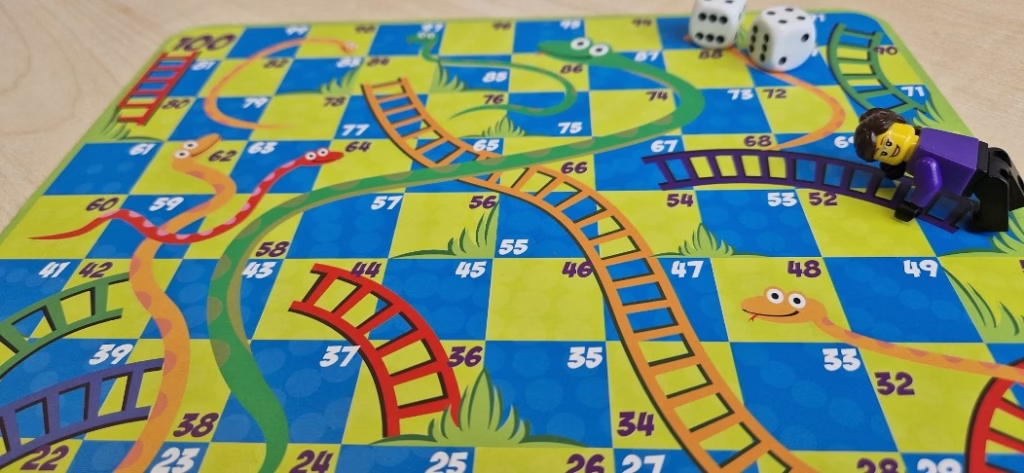
In a previous ACM-W blog post, Empowering Women to Return to Computing: A Game of Snakes and Ladders, I first proposed rethinking the narrative around women’s careers in computing through a new metaphor based on the snakes-and-ladders board game. This metaphor feels closer to the lived experience of many of us: unpredictable, full of setbacks and opportunities, with moments when life pulls us down and others when we find the strength or support to rise again. Most importantly, it is not the end of a journey, as the well-known “leaky pipeline” metaphor suggests, when describing the steady loss of women from computing. Instead, these moments may enforce a pause, or setbacks (but very rarely to “square one”), with almost always a distinct possibility for new paths to be opened in our journey.
As I explained in that post, the leaky pipeline is a simple yet misleading image. It suggests that once women leave, they are lost for good, as if their potential has drained away. That has never matched what I have seen or lived through. Since the publication of that post, I have had opportunities to test my updated metaphor in front of various audiences, including, most recently, as a keynote speaker at the 11th ACM-W Europe womENcourage Celebration of Women in Computing, in Brașov.
When I gave my keynote – “A Leaky Pipeline? Or Pesky Snakes?” – I could not have anticipated how deeply it would resonate with those in the room. Many attendees approached me to say that the talk felt like an acknowledgement of the barriers that they have faced (and still face) as women in computing, which I found extremely moving. In their stories, I observed the quiet perseverance it takes to show up when faced with challenges, overcome barriers, and keep climbing.
For me, there have been plenty of “snakes.” For example, earlier in my career, I found myself in an exciting role but somewhat ended up with an overwhelming teaching load, making it nearly impossible to balance research, family life, and self-care. The deepest hole I found myself in, given my strong self-identity as an academic, was when I had to resubmit my PhD thesis, a process that tested every ounce of my resilience and belief in myself. It was a massive “snake”, one that certainly set me back a few squares on my board. Losing my father in 2020 was yet another one of these “snakes”, a devastating personal blow that very sadly resonated with quite a few of the women in the audience.
And some “snakes” were not mine alone. For example, shortly after graduating from my first degree, I received the heartbreaking news that a dear classmate, who was exceptionally brilliant and successful, had lost his life to mental health struggles that had shown no outward signs to us. His passing was a painful reminder that even among the most promising of us, the unseen challenges can be profound. It changed how I think about success, perseverance, and the importance of kindness in academia.
But what makes this metaphor work is that there have also been ladders. So many, and so meaningful. Mentors who encouraged me when I doubted whether I belonged. Colleagues who alerted me to opportunities at exactly the right time. And above all, ACM-W has been one of the most transformative ladders in my career. Through ACM-W, I have found a community that celebrates every kind of journey. Scholarships that keep making it possible to attend conferences and connect with peers, for example, of which I was a beneficiary in 2013, early in my PhD. Volunteering and mentoring gave me purpose beyond my own challenges. Networking through ACM-W has brought me friendships, collaborations, and a global sense of belonging. What began with me attending womENcourage 2014 as a student has grown into something I could never have imagined: standing on the same stage as a keynote speaker in 2025.
That is why “ladders” are an important part of this metaphor for careers in computing. They lift you up (your spirits, self-esteem and general wellbeing), and they also give you a new perspective, one which Isaac Newton was thinking about when he said “If I have seen further it is by standing on the shoulders of giants”. This is as true in scientific endeavour as in personal career development. True “ladders” allow you to look back and see not just the “snakes”, but the resilience, the growth, and the hands that reached out to help you climb.
My journey, and those of so many others I have talked to, are proven examples that the goal is not to seal the leaky pipeline, but to build more ladders. To create opportunities for people to rejoin, reimagine, and rise again, no matter how many times they have had to start over. Last month, ACM-W took that spirit forward with the launch of U-RISE (Unconventional Routes into Computing: Re-Imagining Skills & Entry), a new section of our newsletter, by Fawzia “Fuzzy” Kara-Isitt, dedicated to celebrating those whose paths into computing have been anything but traditional. The first article of the series features Professor Sue Black, OBE, whose remarkable story from very unconventional beginnings exemplifies the power of resilience and reinvention. Also in this newsletter, we celebrate Professor Mira Mezini’s award as an ACM Fellow, through an interview where she describes her own journey as a “serendipitous path” too.
Stories like Sue’s and Mira’s are especially inspiring to us, as they illustrate that a career in computing rarely follows a straight line, even amongst the most successful and prominent scientists you can think of. It’s like a game of snakes and ladders, in that it is full of challenges, surprises, and second chances. And thanks to ACM-W, you know that every time you land on a snake, there will also be ladders waiting to help you climb again.
About the author:
Dr Adriana Wilde is a Lecturer in Electronics and Computer Science at the University of Southampton, Director of the Centre for Health Technologies, Senior Member of ACM, and Communications Co-Chair of ACM-W. Her research spans human-centric computing, computer science education, and digital health technologies for wellbeing.