
Spotlight on Frances E Allen
by Bettina Bair
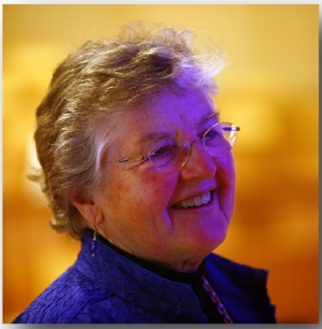
In February 2007, ACM announced that Frances E. Allen would be the first woman recipient of the A.M. Turing Award for contributions that fundamentally improved the performance of computer programs in solving problems and accelerated the use of high-performance computing. The Turing Award was first presented in 1966. It is widely considered the “Nobel Prize in Computing.”
BB: There’s an entry about you on Wikipedia (Frances Allen). How do you feel about this entry? Is it accurate? Complete?
FA: It has an amazing amount of information, nearly all of which is accurate and more comprehensive than I expected.
BB: How do you feel about using technology to support wikis and online communities like Myspace and Facebook?
FA: Our field has helped create the technology that is changing the world – the way we learn, create, and communicate. It is an incredibly exciting period! I believe we are at the beginning of a period in which these technologies will be used to solve the pressing problems of the world.
BB: After you received your Turing Award, you said that you hoped that you could bring attention to the issue of a shortage of women in computing. What changes have you seen in your career, especially in the past few years, that have given you hope?
FA: When I started working as a programmer in 1957, quite a few of my colleagues were women. Computer Science didn’t exist as a field, so credentials for the job were pretty much non-existent. By the 1970s, as Computer Science emerged as a discipline in the Engineering schools and, to a lesser extent, in the Mathematics departments, I noticed that many more men were joining the field. As the discipline expanded, the opportunities for women seemed to decrease. However, my own area, programming languages and compilers, seemed to be the exception for a while. Those topics had emerged early and attracted quite a few women, e.g., Grace Hopper and Jean Sammet, which may explain the exception. I’d really like to see a definitive study on this.
In the past few years, the decline in the percentage of women entering the CS field in the US is nothing short of a national disaster. Why? Lots of theories, no compelling answers. Where to look? Women are entering fields like cell biology, earth sciences and medicine at a rate that will soon eliminate gender gaps in those areas. CS plays a huge role in advances in those fields. So what’s going on? I think Pogo got it right: ‘I have seen the enemy and he are us’. CS has to change.
BB: What advice would you give to computer scientists who want to make a positive change in the world?
FA: Provide ‘computers’ that have natural user interfaces, universal access, bullet-proof reliability, and cost next to nothing. I am a big fan of the ‘$100 computer’ project, but there is a lot more to do.
BB: What technological advances do you think hold the most promise for improving our communities, locally and globally?
FA: This is a tough one. My little village (Croton-on-Hudson, NY) has lots of boards and committees which cover the waterfront. I am on the planning board and several other committees, mostly related to environmental issues. Some day, high-performance computing together with computational models for all kinds of environmental systems, such as storms, migrations, and vegetation, will provide much more accurate, integrated information for communities to use in making decisions affecting the health and welfare of their people and our planet.
BB: Tell us a little bit about how and why you got into a computing career.
FA: When I finished high school, I decided to become a high school math teacher, did that and loved it. After two years, I decided to get a master’s degree in mathematics at the University of Michigan in order to be fully certified to teach. While at Michigan, I took a computer course, was recruited by IBM and joined the company to pay off school debts. Though I planned to return to teaching, one interesting job after another at IBM added up to a long, wonderful ‘career’ in computing.
BB: What words of advice would you like to share with young women who are considering a career in computing today?
FA: Yesterday I met with a young woman who joined IBM Research recently. Here’s some advice I gave her:
Focus on your work, not your career – that will happen later; build professional networks; get multiple mentors and be a mentor; nearly all projects involve teams and there is evidence that diverse tea produce the best results, also they are the most interesting; have fun.
BB: During your Grace Hopper talk, you mentioned that you enjoy hiking. Been on any good ones lately?
FA: My last really good one was a week-long trek in the mountains in Bhutan a couple years ago to celebrate a 70th birthday (not mine) in a tent at 14,000′!
BB: It’s been great to talk to you. Thanks for your time.
FA: You’re welcome. Your questions were really good.