
Spotlight on Dr Gloria Childress Townsend
by Bettina Bair
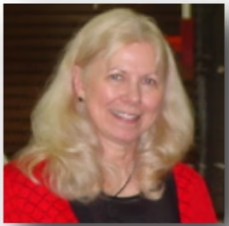
Gloria Childress Townsend has taught Computer Science at DePauw University for more than 25 years, serving as both professor and chair of her department. Dr Townsend is determined that women will be fully represented in her department and her profession. She has carried this determination, which was always evident in her teaching and mentoring of women students, into conference presentations, papers, and grant-writing. Recently, Dr Townsend accepted a position on the Executive Board of the new ACM-W Council.
I interviewed Dr Townsend via email.
Bettina: Tell a little bit about how and why you got into a computing career.
Gloria: I chose computing (or it chose me) after years of studying Mathematics. In my undergraduate years, no computer science classes existed at Indiana University Bloomington. I discovered computing through programmable calculators (of all places) and continued exploration by “reading a book” and teaching myself Pascal to work on a queuing problem involving banks. As many other Mathematics degree holders in the late 70s and early 80s era, I then “retrained” by taking formal Computer Science classes and forged a new career teaching Computer Science.
On a personal level, I chose Computer Science, because I lost very little of the beauty of Mathematics but found freedom (which is really important to me) to explore a wider swath of the world of science. It seems to me that (with a PhD in Mathematics) one concentrates on a very small area of Mathematics and rarely ventures beyond the boundaries of that area. One solves problems and writes proofs in both Mathematics and Computer Science, but I’ve grown to appreciate and enjoy algorithmic tools along with proofs.
Bettina: What’s going on with your research in the fields of Artificial Life and Computer Ethics these days that’s new and promising?
Gloria: I’m working in a sub-area of Artificial Life called Evolutionary Computation (EC). The area excites me because I’ve chosen to apply computing research to Biology and Mathematics, working within a team composed of three scientists, representing the three fields. We recently completed a multi-year NSF grant project (Population Biology) investigating problems (butterflies, barnacles, snails) and using tools from all three disciplines. This current semester, we’re polishing off a Biology paper with the biologist as the lead author, and I’m writing another paper for the EC community, as the lead author.
I feel that each of us who works to recruit and retain women in computing is engaged in Computer Ethics (CE) efforts, because I subscribe to the beliefs of Deborah Johnson and Keith Miller, as spelt out in their excellent editorial, “Is diversity in computing a moral matter?”
Bettina: With all of the research, awards and travel in your life, what are you doing for fun? And how do you find time for it?
Gloria: We have a “first grandchild” and are thoroughly smitten. My husband and I enjoy animals and nature too. He’s feeding a huge crop of birds, and I love to watch them. This year, about twenty blue jays arrived, where only two or three visited in years past. We also indulge five cats, one dog, her live-in boyfriend and a ferret. Our house lies about a mile from a state park, where we walk and feed a feral cat.
Timing has become easier since my husband’s retirement. He’s always helped to shelter my career, but he has even more time to engage now. For example, I’m on sabbatical and taking a course in robotics at Indiana University Bloomington. Don drives me to class every day, so I don’t need to be concerned about snow and parking.
Bettina: The proportion of women in computing has been decreasing for some time. How do you respond to critics who say that this is a natural course of events and that it is unproductive to push women into technical fields?
Gloria: I return to Deborah’s and Keith’s article – a must-read, by the way. If readers have not examined the editorial or have forgotten it, they should look through the ACM portal without fail. I agree with the authors’ expressed view (and the great analogy of bald-headedness as a job prerequisite) that (whenever there are artificial and unfair requirements for a discipline, major or career) the number of individuals most disenfranchised by the real or perceived requirements will decline. So, to answer your question, I think that the decrease is unnatural and that it is very productive for ACM, ACM-W, NCWIT, ABI, CRA-W and all other organizations dedicated to computing equity to work together to remove the artificial and unfair “requirements” (or the perception of the requirements) for computing.
Bettina: You have been a very active member of the ACMW, and now you are a member of the ACMW Council Executive Committee. Where do you see ACM-W in five years? What kind of organization will it be? And with what mission/goals?
Gloria: I’ve seen a trend of much more cooperation among organizations dedicated to computing equity developing for some time. The trend is so encouraging and uplifting. I believe that the trend will continue and that in five years we’ll see a coalition of gender workers dedicated to common principles linked together, practicing the art of synergy.
ACM-W’s milieu, K-through-undergrad, defines us by demonstrating our strength for helping girls and women in the critical years of the Pipeline, as does our relationship to Computer Science’s professional organization. We will undergo the expected transition over the next five years, strengthening our effective recruiting and retention projects and acquiring new projects and project leaders that befit the current “rebooting of computing”. We will continue to celebrate women in computing and to build communities to sustain them, as my own ACM-W project (Regional Celebrations of Women in Computing) maintains as a goal.
Bettina: You’ve been successful at expanding your influence to create such programs as the Regional Celebrations of Women in Computing. What advice do you have for young women in computing on overcoming obstacles like culture and distance to become leaders?
Gloria: Besides the natural benefits of involving oneself in education and an eventual career in computing (where there are so many paths of interest), a great deal of satisfaction and pride come from being a pioneer in gender issues, especially with the pursuit’s ethical tones. I advise women to “reframe” situations. For example, I have heard women in smaller universities – with no female instructors or colleagues – bemoan the lack of mentors. This situation offers an opportunity, not a difficulty. ACM-W’s Student Chapters project allows one to charter a local chapter with only two students. If one has no mentors, then become a mentor. Almost all women want to help others; helping others seems to be our universal (and admirable) motto. By helping others, we help ourselves – along with influencing the generation of women in computing who will follow us.