
Spotlight On Barbara J. Grosz

Photo by Kathleen Dooher
Barbara J. Grosz is Higgins Professor of Natural Sciences at the Harvard School of Engineering and Applied Sciences (SEAS) and dean of the Radcliffe Institute for Advanced Study at Harvard University. Recently, she was awarded the Allen Newell Award from the Association for Computing Machinery (ACM)/Association for the Advancement of Artificial Intelligence (AAAI) (see Awards this issue).
Grosz was recognized for her contributions to natural language processing, the study of the basic structures and processes by which people use natural languages to communicate, and her more recent research on the development of multi-agent systems, ‘smart’ and adaptable computer algorithms that collaborate with each other or with their human users.
She is also a member of the ACMW Council Executive Board. I interviewed Dr Grosz by email on June 30, 2009.
Bettina: Tell a little bit about how and why you got into a computing career.
Barbara: I got into computing entirely by accident. My seventh-grade math teacher, who taught binary arithmetic (among other, more ordinary topics), was the first person to tell me that girls could do math. My fond memories of that middle school class and its section on binary arithmetic led me to audit a Cornell University computer science course, wonderfully taught by John Hopcroft. That course heightened my interest in computing, as did working for IBM one summer during college, and eventually led to my going to graduate school in computer science.
I gravitated to my initial research area because of a shared conviction with Alan Kay that educational software systems could be far better than they were. Working with Alan on his Smalltalk language development project in the early 1970s convinced me of the vast potential in the intriguing field of natural-language processing.
Bettina: What’s going on with your research these days that’s new and promising?
Barbara: Two of my current projects illustrate the wonderful interplay between theory and application, as well as the role of empirical investigations. S-CASTS, supported by NSF grant REC-0632544, addresses the challenging problem of a computer system that infers the strategies of middle-school students who are using datamodeling software to learn about statistical data by building and analyzing their own models. Our system design draws on earlier work on the SharedPlans model of collaboration (Grosz & Kraus, 1996, 1999), and the collaborative interface uses even earlier theoretical work on the structure of discourse (Grosz & Sidner, 1986). We empirically evaluated our plan recognition algorithms using data collected with colleagues who develop middle school curricula and educational software. Currently, we’re exploring the extension of these ideas to the development of a collaborative interface to software for teaching chemistry through laboratory simulations.
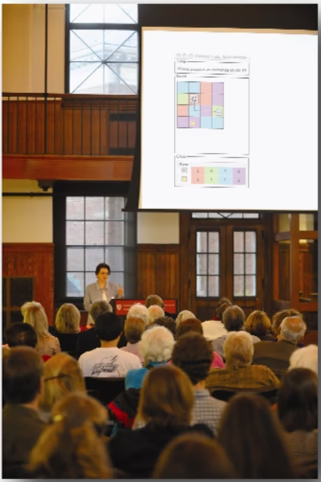
Photo by Tony Rinaldo
The second project, decision making for collaborative tasks (supported by NSF grant IIS-0705406), focuses on the design of computer-agent strategies for deciding whether and when to help teammates in a collaborative activity. It’s a step in a longer-term research effort aimed at improving computer agents’ decision-making when they work in groups with people. This work also draws on SharedPlans, merging that logical specification with a decision-theoretic mechanism, which can reason about costs and benefits, to provide a novel hybrid model and a new probabilistic representation that enables the compact representation of agents’ beliefs about each other’s ‘recipes’ for doing complex activities. We have tested our new techniques using a multi-agent test bed called CT. One of the postdoctoral fellows who has worked on this project is now using CT to study decision-making in different cultures and societies. This demonstrates the wide applicability of computer science research that is rooted in theory and takes human cognitive capacities into account. It’s also evidence of the wonderful rewards of being a professor whose students inventively tackle challenging problems using new computational mechanisms.
Although being dean of Radcliffe leaves me less time for research, it, too, has rich rewards and indirectly influences my research. It is a superb culmination of years spent designing and leading major interdisciplinary initiatives, including the Natural Language Program at SRI International and the Centre for the Study of Language and Information, a joint venture of Stanford University, SRI International, and Xerox PARC that I cofounded. Radcliffe annually brings together forty to fifty fellows from a wide array of academic and artistic fields; the fellows themselves say their presentations and cross-disciplinary conversations are an ‘intellectual feast.’ I’m also very excited about Radcliffe’s faculty-led academic engagement programs, which continually engender new and promising collaborations and research endeavours.
Bettina: With all of the research, awards and travel in your life, what are you doing for fun? And how do you find time for it?
Barbara: I love gardening, watching movies, hiking in Yosemite, and cooking dinners with friends (and baking chocolate chip cookies for their kids and my nephews).
How do I make time for it? I just do. However challenging it may be, we must simply make time for fun. Getting away is important for gaining perspective and new insights. Those who need a work-related incentive to do so should note that Radcliffe Institute fellows often report that answers to some of their most complex problems emerge in moments of relaxation and deliberate mental shifts away from their research.
Bettina: The proportion of women in computing has been decreasing for some time. How do you respond to critics who say that this is a natural course of events and that it is unproductive to push women into technical fields?
Barbara: I say that they’re wrong…completely. Computing is where the action is. It’s the way of the future, and it brings much to bear on many fields. There’s absolutely no reason why women shouldn’t be as excited as men about the incredible potential for innovation in computer science, and they’re certainly as capable. The declining proportion of women in computing is an unfortunate trend that we must work relentlessly to reverse–we cannot possibly produce the best computing if half of the human race is absent from the design process.
Bettina: You’ve achieved a significant amount as a woman in computing. What advice do you have for young women in computing on overcoming obstacles like culture and distance to become leaders?
Barbara: Listen to those who encourage you and ignore those who don’t. Track down people who can be resources and don’t tire of asking them questions. There are numerous outstanding people in computing. Find people like Allen Newell and Elaine Weyuker and go where they are to study and work.
It’s also important to take charge. Grace Hopper is often quoted as saying, ‘If it’s a good idea, go ahead and do it. It’s much easier to apologize than it is to get permission.’ That’s excellent advice for young women in computing. Just go for it!
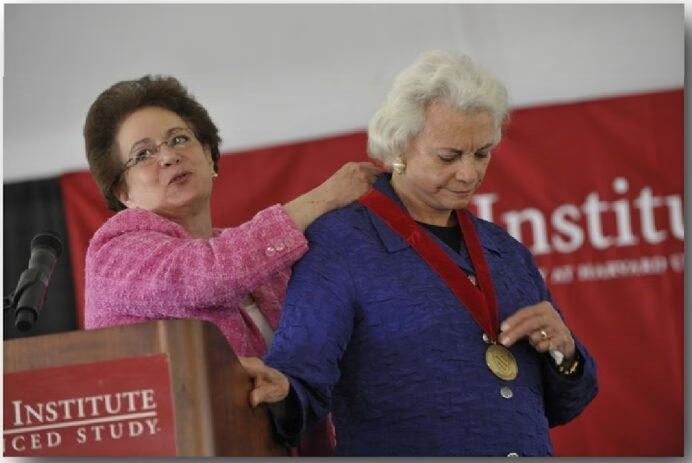
Photo by Tony Rinaldo