
Ask Judy
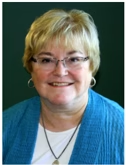
Judy Olson is the 2011 ACM-W Athena Lecturer. After 40 years in both academics and industry, she has encountered a lot of sticky situations, survived, and, through every phase, was happy. She has advised many younger women in her career and thought she could broaden her reach by contributing this column.
The Never-ending To Do List
Dear Judy:
My advisor is always giving me too much work to do and I am overwhelmed by what to do first. What should I do?
Drowning
Dear Drowning:
Time management is the key here, and perhaps in a future column, I’ll write up my take on how to do that well. But for now, briefly:
- Make a list of everything for work
- Make another list of everything personal
- Estimate how long each of these is going to take
- Count it up (the total across two lists)
- Indicate your own priorities (across both lists)
- Take the work list to your advisor
- Ask for advice about priorities, introducing it with the phrase, “Help me think through this … “
Many advisors, upon seeing that there really is a problem and recognizing how thoughtful and thorough you are, will give you advice about which tasks can be delayed, dropped, or given to someone else.
Then read this column next time for a more thorough lesson in Time Management.
Judy
Local Community Talks
Dear Judy:
I am regularly asked to give talks in my city about my research. The audience is typically filled with community members rather than peer academics. Should I do it?
Puzzled
Dear Puzzled:
It is always flattering to be asked; someone is interested in what you do. But my swift first answer is “no.” It doesn’t count towards promotion.
However, there are some reasons to do it. By making your work accessible to non-academics, you practice saying why this work matters. This practice leads to writing good “Broader Impact” statements in your grant proposals and convincing people that you’ve chosen an important problem to work on.
Second, if you need access to organizations for your research (e.g. small business owners who need different technologies than are available), this is an opportunity to make contacts and follow up with interested people.
Other than that, say “no” and spend your time on research! It’s hard to say no, but you have to practice saying it in a lot of different, but nice ways. Recently, I said no in the following ways:
- Thank you for inviting me to contribute to the book. It looks very interesting. Unfortunately, the timing is not right. I am involved in X and Y and will not have the time to devote the effort to this project properly. Let me suggest NAME1 and NAME2 as possibilities.
- Thank you for the opportunity to be the local representative for Y. It is a cause that I strongly believe in. Unfortunately, I am not able to participate at this time. My responsibilities in X and Y are taking up all my time right now, and I would not be able to devote enough time to do the job well. NAME1 and NAME2 are people who might be able to devote some time. Again, thank you for asking.
Judy
Unsolicited Job Offers
Dear Judy:
Every once in a while, when I’m giving a research talk at another institution, people ask me if I would consider a position at their university. What should I say?
Asked but not answered
Dear Asked:
Wow. This never happened to me! How flattering.
But this answer has a lot of “well, it depends” in it.
It depends on who’s asking.
- If a junior person, this is just an expression of enthusiasm for your work. Smile and say, “Thank you. I’m flattered. I don’t know.”
- If it’s a senior person, this is more serious. They may have the power actually to do something to attract you to their department. Then there are more “it depends:”
- If it’s a place you know and would like to be, you can say, “Thank you for the vote of confidence. We could talk.”
- If it’s a place you would not like to be, you can say, “Thank you for the vote of confidence, but I’m happy where I am.”
- If it’s a place you don’t know if you’d like to be, you can say, “Thank you for the vote of confidence. I’m not sure I know enough about how things work here and who all the people are. You talk to your colleagues, and I’ll do a little research, and if things look good on both sides, we can talk.”
It’s always nice to be wanted.
Judy
When to Disclose Two-Body Opportunities
Dear Judy:
I am part of a two career couple. In a job hunt, when do I disclose this issue? What are the possible responses?
Two Body Opportunity
Dear Two body:
This is a tricky one. My first reaction is to tell people early. But then, I always assume people are nice and will do the right thing. Not so, I’ve discovered.
The worry is that you will not even get an interview if people think they will have to do extra work to help you find a suitable position for your spouse/partner. That’s technically not legal. You have to be given equal opportunity. But nobody’s policing what’s going on inside the search committee’s heads.
So, I think the wiser course is not to disclose it until you have an offer. People may have hints earlier in the process and do the right thing, but if not, itÕs in the offer negotiation that this has to come up.
What kinds of things might they be able to do to accommodate?
- If the spouse/partner is in academics, the chair will negotiate with the appropriate department for a “spousal accommodation”, which might involve money from central administration to cover either part of the other position or the other position for a period of time (e.g., 3 years). The spouse/partner would then have to interview just like a regular position, except there’s no competition for the slot. The person has to be someone who fits and is of sufficient quality for the faculty to find acceptable.
- If the person is non-academic, the central administration often offers job search help or connects the person to a local service.
- Sometimes the hiring organization will do nothing. Bummer. Then you have to find a job on your own. But doing nothing to help is a signal about how much general support they offer and may affect your decision to accept.
On the up side, hiring organizations should know that if they do accommodate, the couple is likely to stay with them and thrive.
Judy