
Voices of ACM-W: Lynda Hardman on Moving from Data to Meaning
How Computing Environments Shape Society and Inclusion
By Cigdem Sengul
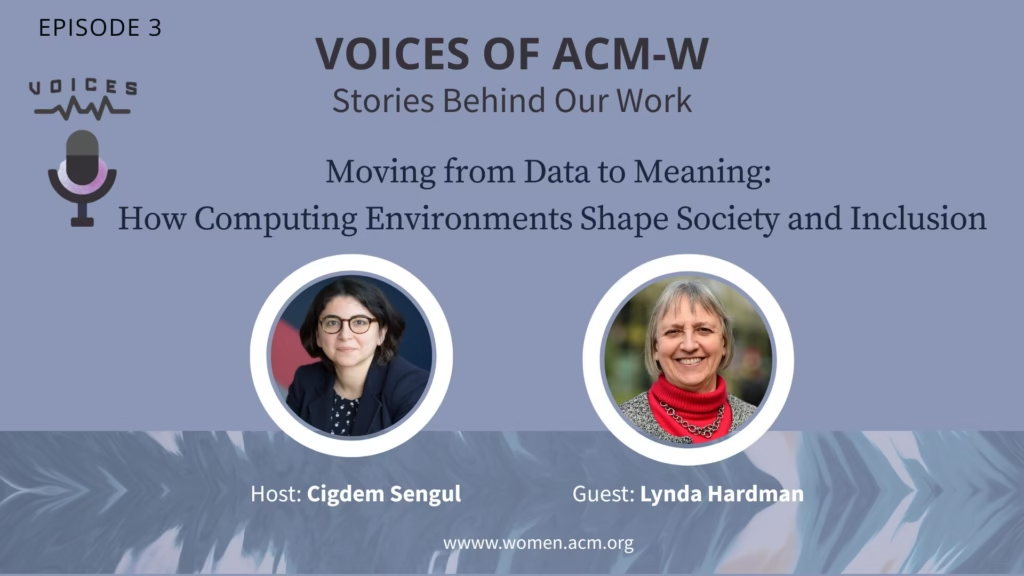
Imagine a world where technology doesn’t just process information but truly understands and shapes our society. Whether it’s hypertext, multimedia, or AI, each step brings us closer to computing environments that work for everyone. In this post, we explore how foundational research, standardisation efforts, and diversity initiatives can shape the future of computing – making it more inclusive, impactful, and human-centred. We’ll draw insights from this month’s Voices of ACM-W guest, Lynda Hardman, a pioneer whose work spans academia, industry, and international standards, whose work has been shaping how moving from data to meaning can unlock societal and gender equity in tech.
The Journey from Hypertext to Human-Computer Interaction
Lynda Hardman’s transition from physics and mathematics into computing showcases how curiosity about meaning and communication drives technological evolution. Early hypertext systems, like the programs she helped develop, laid the groundwork for modern multimedia and web technologies. Her fascination with how we learn and extract meaning from information – text, sound, images – has remained central throughout her career. Back in the 1990s, hypertext was a novel way to structure information, making it easier for users to navigate complex data. Today’s HTML5 and multimedia standards owe much to those foundational efforts. Hardman’s involvement in the development of SMIL (Synchronized Multimedia Integration Language) exemplifies how academic research can influence web standards that serve billions of users.
Standardisation: A Path to Real-World Impact
When Lynda joined the W3C working group on SMIL, she was doing something many researchers never attempt: walking into the room where standards get made. Those rooms, which include not only academics but also browser vendors and discussions of competing commercial priorities, as well as complex implementation trade-offs, are where research may become real. She stayed and contributed to a standard now quietly embedded in digital signage, multimedia messaging, and SVG animation worldwide. For any young woman wondering where her work can reach: that’s one answer.
Diversity, Gender Equity, and Making Computing Inclusive
A recurring theme in Lynda’s journey is her active commitment to gender equality and supporting women in tech. This is also how I first got to know her in 2014 – as a panel organiser for the first-ever ACM-W womENcourage in Manchester, UK.
As the first female president of Informatics Europe, she spearheaded initiatives such as creating gender guidelines and distributing them as informative booklets, which were also distributed in that first ACM-W womENcourage. The booklet is packed with effective strategies for ensuring more women participate in informatics research and education.
Another booklet, “Why would I want to do a PhD in Computer Science? (2023)” tackles one of the most underleveraged moments in the computing talent pipeline – the point where talented undergraduates, especially women, talk themselves out of research careers. Lynda’s work here has reconnected us, and we are exploring how ACM-W might adapt this for our own community. More on that later this year.
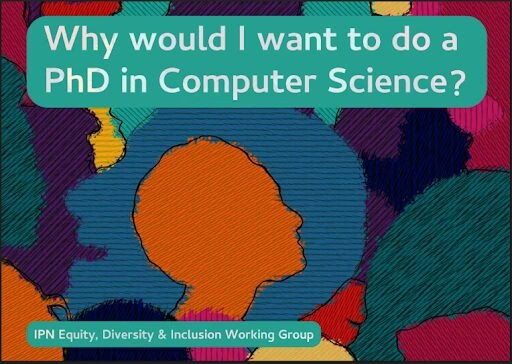 Why would I want to do a PhD in Computer Science?
 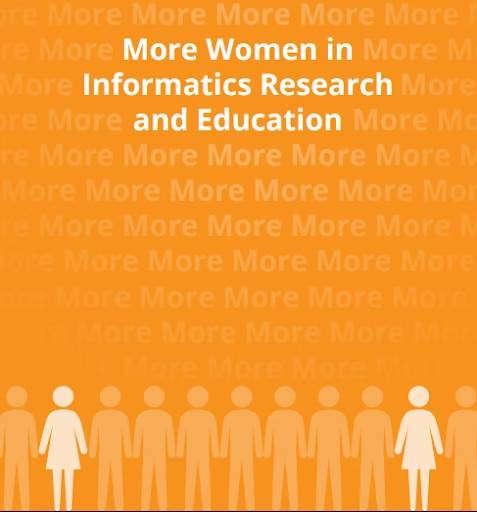 More Women in Informatics Research and Education
Lynda’s efforts demonstrate that authentic progress requires community-driven, collaborative approaches. Her own advocacy story, starting from being nudged into leadership by supportive colleagues to leading initiatives, shows the power of community and mentorship.
We also discussed how we can all contribute by amplifying minoritised voices, sharing stories, and building networks that support diversity. Even small actions, like advocating for inclusive visuals in presentations, can foster meaningful change.
The Power of Stories: Communicating Societal Impact through Computing
Storytelling is at the heart of human engagement with information. Hardman’s keynote at womENcourage in 2016, titled “From Linked Data to Stories,” illustrates how annotations, models, and narrative structures help machines understand and generate meaningful content. Her research explored integrating multimedia annotations – text, sound, and video – to analyse and craft narratives, revealing how technology can mirror human storytelling.
On the other hand, LLMs can now produce fluent, structurally coherent text, but fluency isn’t the same as having something to say. A story with a message isn’t just well-organised information; it’s the product of a perspective, a motivation, a reason for telling it at all. Think of the difference between a news summary and a piece of journalism that changes how you see an issue. Human storytellers possess lived experiences, motivations, and nuanced understanding that drive impactful narratives; this remains a challenge for machines to fully emulate.
Stories matter. Stories are how communities recognise themselves, how injustices get named, how change gets imagined. If the systems generating content at scale lack genuine perspective and lived experience, what we get are voices averaged away. For women and other marginalised groups, this is a concern, and we should keep asking: whose meaning is this technology actually serving?
Looking ahead, Hardman is actually positive about the potential of AI to include more women in computing, highlighting the importance of societal context in technology adoption. She advocates for digital humanism, an approach that considers societal, ethical, and humanistic perspectives, especially when deploying AI applications that impact work and equity. We discussed how technological change is swift, and society often struggles to keep pace with reflection. The narrative often oscillates between AI empowering underprivileged groups and AI replacing jobs, particularly those held by marginalised communities. It’s crucial to encourage inclusive discussions to ensure AI benefits all, mitigates inequalities and enables all to write their own stories.
Final Reflections: What Would You Tell Your Younger Self?
Reflecting on her early career, Hardman advises young women to enjoy the ride, balance work and family, advocate for workplace flexibility, but make it a joint decision. Her advice: both partners move to a four-day work week, so the load is shared equally rather than quietly absorbed by one person.
She emphasises that the environment plays a significant role: if you find yourself in a toxic or unchangeable climate, leaving might be the best option. Her story encourages us to recognise and leverage our non-linear career paths, embracing diverse experiences to shape our identities and contributions. The key takeaway? Your varied experiences- be it in industry or academia – are valuable assets. Stand firm in advocating for yourself and others.
Wrap-Up: Taking Steps Toward Inclusive, Impactful Computing
Lynda Hardman’s journey exemplifies how foundational research, community collaboration, and advocacy can shape computing to be more human, societal, and inclusive. Her insights remind us that storytelling, diversity, and societal impact are central to future innovations. As you reflect on your own path, consider the small actions, such as mentoring a colleague, championing inclusive visuals, and sharing impact stories and how they can initiate broader change. Together, we can build computing environments that truly count: environments that embrace meaning, impact, and equity to society.
Listen to the Full Conversation
Our Guest
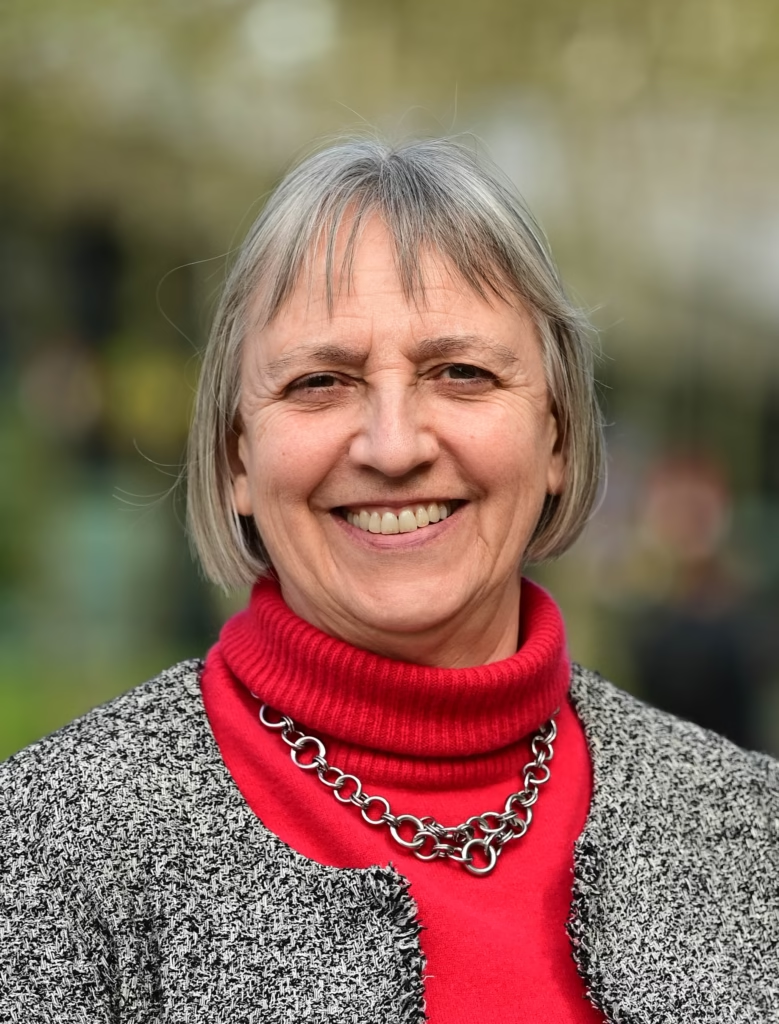
Lynda Hardman is a Principal Researcher and Strategist at the Centrum Wiskunde & Informatica (CWI) in Amsterdam, and Professor in Multimedia Discourse Interaction at the University of Utrecht, The Netherlands. Her research focuses on creating linked-data-driven, user-centric applications for exploring information. She also investigates the use of augmented reality to explore brain regions and related brain diseases through the Linked Brain Data repository. Previous research interests include document models for hypermedia and synchronized multimedia on the Web (SMIL).
She was the president of Informatics Europe, the association of computer science departments and research laboratories in Europe and neighbouring areas, from 2016-2017 and past president from 2018-2019. As founding chair of the Women in Informatics Research and Education working group, she edited the first edition of the booklet More Women in Informatics Research & Education. I edited the research and society section on Women in ICT Research and Education.
Photo Credit: Thijs ter Hart