
We Are More Alike Than We Are Different
By Bob Rimington (edited by Adriana Wilde)
This coming Pride Month, like many before it, is a celebration not unmarked by sadness. Around the world, conversations about gender identity, inclusion, and human rights continue to take place… and not always in ways that support the people most affected. In the UK, where I am based, the Equality and Human Rights Commission (nominally an equality watchdog) has recently updated its code of practice to exclude trans people from using the single-sex services of their lived gender. Instead, they must use the services that align with their assigned gender at birth. In practice, this means the exclusion of trans people from necessary services and spaces. Women’s refuge shelters, for example, are at risk of losing their funding as ‘single sex spaces’ if they accept transgender women. Ironically, those same shelters are welcome to exclude transgender men on the grounds that they are too masculine. Make no mistake, the lives of trans people will be impacted for the worse by this decision, but so too will the lives of cisgender women. A law that targets a minority group for exclusion must have exclusive criteria, and in this case, that is the convincing performance of a sanctioned ‘biological’ femininity. I wonder, at what point will a post-menopausal, gender non-conforming, or butch woman not look ‘female enough’ to use a toilet?
This is not an isolated, local issue in my country. In many other places, policies and social attitudes continue to restrict access to everyday spaces and services for transgender and gender-diverse people. The effect of these changes ripples beyond the most affected minority group, shaping how whole societies define identity, belonging, and safety for everyone.
At a time when many global challenges (e.g., environmental, social, and political) require collaboration and empathy to navigate uncertainty, it can feel as though societies are becoming more divided, more cautious, and more focused on difference. The driving force behind women’s groups involved in anti-trans activism is, in my opinion, self-evidently fear, and a belief that safety will come from separation. This is echoed at larger scales in communities, societies, and countries that are growing increasingly inward-turning, suspicious, and xenophobic. The idea of trusting one another, or working collectively towards shared goals, is sometimes framed as naïve rather than necessary.
But it is precisely in these moments that we are called to respond. It is our responsibility to resist these ‘doomer’ narratives. As a non-binary person, I inhabit both masculine and feminine spaces. It can be lonely; being non-binary means continuously navigating situations where expectations don’t quite align with who you truly are. This includes being misgendered – even by well-meaning people – and usually getting a double-take after I give my name. I am still visibly female, and experience all the intersectional aggressions that cisgender women experience – while also feeling like an interloper attending women’s events (heck, I feel like an interloper writing this newsletter for ACM-W!).
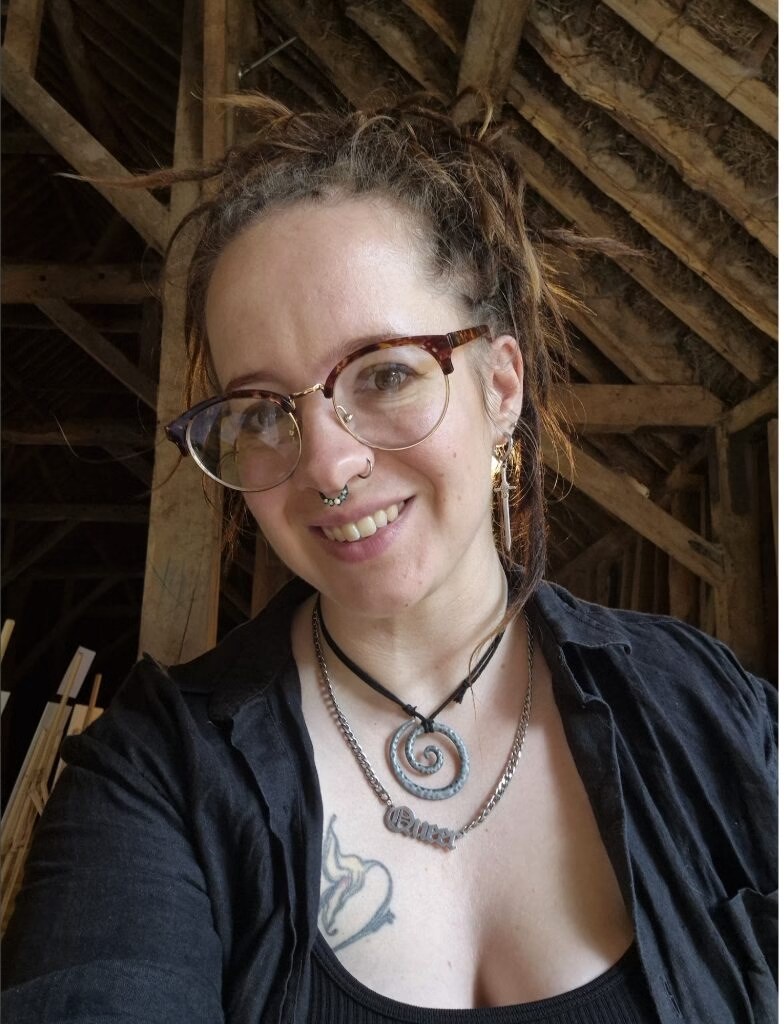
And yet, much of the experience is also joyful. Living authentically brings a sense of freedom and clarity that outweighs the challenges. There are unexpected advantages too: freedom from certain social expectations, flexibility in how I express myself, and the opportunity to engage with a wider range of perspectives and communities. For example, I never feel pressure to shave my legs, I enjoy all the leg-room of the accessible toilets, and everyone who dates me is a little bit queer by osmosis. I shoulder my way into male-dominated spaces from stag parties to STEM, and still wear dresses because they’re pretty.
From this perspective, Janus-like, images of masculinity and femininity as oppositional are faintly absurd. The “opposite gender” is not an enemy, and gender as a simple binary is neither a biological nor experiential reality. In the words of the Pride pin a colleague gave me, ‘Binaries are for computers, not people!’ Human identity is far richer and more complex. The notion that one group must be protected from another often stems from fear, when in reality, shared understanding is far more powerful than separation.
This perspective also shapes my research: I am no more capable of settling on a single discipline than I am of settling on a single gender or sexuality. While my first degree was in Film and German, I followed my interest in what makes people tick to an integrated PhD in Web Science, studying toxic behaviour in online games through digital ethnography. I then spent five years in industry as a mixed-reality and escape room game designer, before returning to research. Again, this can make things awkward. Academic departments and knowledge can be remarkably siloed, and as an early-career researcher it can be difficult to know just how to position myself in terms of specialism. I’m glad to say that the value of interdisciplinary thinking is becoming more visible, as I believe that technologies are ubiquitous assets with a great deal to offer the arts and humanities – and arts and humanities perspectives will be crucial in building an equitable digital future. Now, as a researcher-practitioner in game design, I am privileged to work at the intersection of art and technology. I explore how playful, mixed-reality experiences can help people connect more deeply with places, each other, and themselves. I am particularly interested in how games can reframe the world; not as something fixed and rigid, but as something open, creative, and full of possibility.
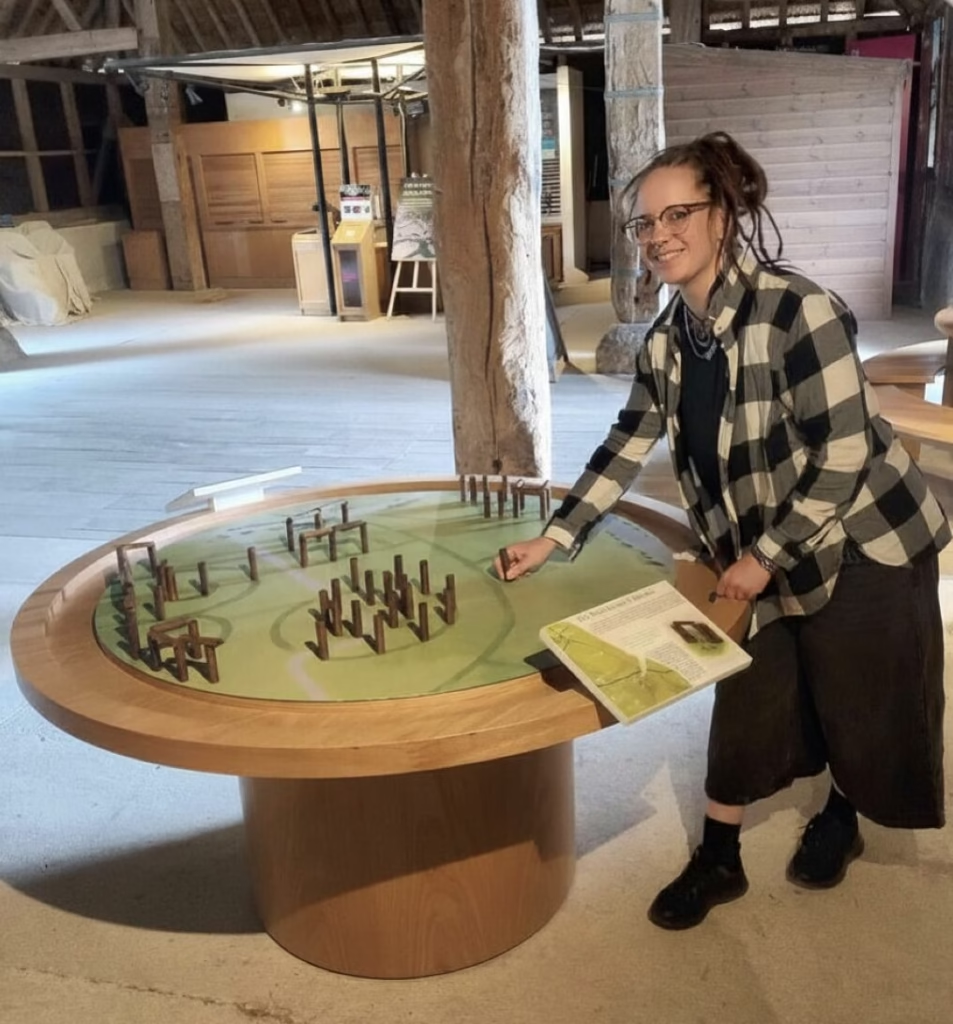
Play allows us to experiment, to imagine, and to empathise. It invites us to step into perspectives that differ from our own and to engage with complexity in ways that feel accessible and meaningful. Through both my work and my lived experience, I return to a simple but powerful idea:
We are more alike than we are different.
What a better occasion than Pride month to reflect on this idea?
About the author: Dr Bob Rimington is a mixed-reality game designer and an early-career interdisciplinary researcher. They have created immersive experiences worldwide including escape rooms, locative games, and crazy-golf courses. Most recently, they’ve been a research fellow on the Horizon Europe LoGaCulture project at the Universities of Southampton and Bournemouth, creating interactive heritage experiences for Avebury’s Neolithic henge and stone circle. Their latest pictorial, In Search of Lost Times: Reimagining Mixed Reality Games for an Ancient Site, will be presented at ACM Creativity and Cognition in July 2026. They can be found on LinkedIn and at bobrimington.com