
Finding New Technology Opportunities in a Changing Economy for Women of a Certain Age
By Paula deWitte

Women were among the first programmers and have contributed to the computer industry since the very beginning. There has never been a gender bias, as with other older engineering disciplines, although the number of women entering the computer science discipline is declining. Today, when many women reach a ‘certain age,’ they no longer find a computing career. What are their career paths? Mid-life career redefinition is the new economic reality and may help account for the declining numbers. This article discusses how women can leverage their computing and analytical skills to transition into a new and rewarding career when they reach that mid-life, mid-career point. Opportunities include both traditional, logical choices, such as becoming teachers or entrepreneurs, as well as the less obvious choices. There are also many overlooked opportunities that build on a woman’s experience and expertise in technology. This article does not provide a definitive list, but rather a framework for beginning to consider some of these career alternatives, as well as how women must proceed in their mid-life redefinitions. The computing industry should address this issue and help mid-life women, or risk losing significant experience and expertise from the young who pick alternative disciplines and from the older who no longer work in the field.
Jean Bartik, who passed away in April 2011, was a pioneering female computer programmer whose work earned her the IEEE Pioneers Award and the Computer History Museum Fellows Award (Lohr, 2011). Ms Bartik led the ENIAC programming team and worked with John Eckert and John Mauchly in the nascent field of computer programming. When Ms Bartik lost her job in 1986 at the age of 61, she could no longer find employment in the computer industry and spent the rest of her life working as a real estate agent.
Ms Bartik’s experience of no longer finding work in a field she loved is not unique. Many midlife women in computing find themselves in Ms Bartik’s shoes, wondering ‘What’s next?’ when a career ends, perhaps more suddenly than anticipated. There are obviously some exceptions. Most of the ‘women of a certain age’ who continue to work in the computer industry are tenured university professors or high-level corporate executives. But these success stories are overshadowed by the larger number of women over the age of 50 who are finding themselves forced out of an industry they still love.
From the beginning, the computing industry provided opportunities to women throughout the ranks – programmers, analysts, designers, and leaders. As a newer discipline, there was never the issue of whether women could be successful. Women, such as Ms Bartik, were a part of the nascent computer discipline.
The computing industry openly attracts and solicits the young, many directly from college. Software engineering is ranked as one of the most sought-after, better-paying, and highly satisfying jobs. Almost any media depiction of programmers, including the front banner of the ACM-W website, is populated by young faces. There lies the conundrum. Building successful computer systems depends on understanding more than programming. Computer technologists must know the theory and application of algorithms and use analytical and communication skills. However, the industry focuses on programming skills, ignoring other skills that are independent of specific computer languages, and prefers younger programmers.
Mid-life careers end for myriad reasons. There is a constant challenge to keep current technology skills. An old Doonesbury cartoon’s punch line (Trudeau) predicated the bankruptcy of a successful software technology company because the entrepreneur had gone to lunch. Change is that fast. It’s disruptive. The constantly challenging environment to learn and innovate draws us to technology. The challenge is a double-edged sword. Those in their twenties and thirties may not realize how difficult the constant retraining becomes until they reach their forties or fifties. It’s not that mid-life women cannot learn new technologies or stay current, but rather we tend to develop a ‘been there/done that’ response from the constant learning cycle new technologies and paradigm shifts bring.
My own career began with college classes where I used a slide rule for calculation and programmed mainframes. I long ago lost count of the number of computer languages I learned, beginning with Fortran and Assembler, including PL/I ( Who remembers PL/I? ) and even a bit of ‘the last programming language ever needed’ ADA, and ending when I last programmed my artificial intelligence-based dissertation work on a LISP machine over twenty years ago. Do I think about returning to programming? Last year, I purchased books intending to learn new programming languages. The books, the excellent ‘ Seven Languages in Seven Weeks ‘ (Tate, 2010) and books on PHP and web programming, sit on the bookshelf in deference to my reading Steven Johnson’s books, such as ‘ Where Good Ideas Come From ‘ (Johnson, 2010) and researching privacy and security laws.
The constant technology change is not the only reason midlife women find themselves without a clear career path. Some women left technical jobs to move into management positions that disappeared in this ‘Great Recession’ and have no similar job options. Many lose their jobs quickly without time to plan for a smooth career transition. Other women, such as myself, burn out, finding themselves in a once successful career that no longer personally satisfies. It’s a double-edged sword – the need to learn and innovate initially attracts us, but eventually leaves some without careers.
Some women decide to pursue other career dreams before it’s too late. Regardless of the reason for being unemployed , under-employed , or unhappily employed , women, like men, of a certain age face the reality of being ‘too old.’ Anecdotally, I haven’t met a single technical individual over 50 who lost his/her job in the Great Recession and was hired at a similar job. Beyond computing, I’ve met a mechanical engineer turned locksmith, a patent attorney who spends her time quilting, a software person who worked for the major 100-year computer corporation and now works in a mall chain retail shop, and some recently laid-off NASA shuttle engineers who believe they may never work in their fields again.
The stubborn, high unemployment rate is significantly higher for those over 50. The reality is that most individuals in their fifties plan to live another 30 productive years. With extended life spans, depleted retirement accounts, or concern about their long-term economic future, many Boomers want to continue working, either because they don’t want to or can’t afford to quit.
Many are women who broke through barriers to enter traditional male jobs and want to continue to work and contribute, but lack a clear career direction for a discipline still loved. The salient observation is that there is a tremendous cost to society in terms of lost opportunities and economic value when these women’s collective skills and knowledge are no longer used.
As Francis E. Allen, the first female Turing Award winner, noted, more women were entering the fields of cell biology, earth science, and medicine, while the number of women in computer science continues to decline or in Ms Allen’s words, ‘a national disaster’ (Bair, 2008). It is possible that some women decline to enter the field because the chance for a lifetime career may be greatly improved by choosing the sciences over computing.
Life lessons, if not wisdom, come with age. There is a significant expertise, experience, and skill base that complements what is taught at the university. Programming paradigms change; however, there is a constant body of knowledge gained through real-world experience, such as conducting research, generating business, managing projects, starting and running companies, managing employees, and interfacing with customers. No matter how outstanding universities are, they can’t teach this real-world experience. This is what society loses when experienced women turn their backs on the computer industry. I strongly believe that Ms Bartik, in her 60s, still has much to offer the industry.
What happens to those of us with the philosophy to live like we’re 50 until we’re 80? (Crowley, Henry S. Lodge, & Sheehy, 2007) Or perhaps, to re-state the question: Where does a mid-life woman look for new computing career opportunities?
To explore that question, let me share my story. In my twenties, I considered myself a hotshot programmer. I’m not sure I ever considered what I’d be doing in another 25 years. My undergraduate degree is in mathematics, my first graduate degree in education, but after a few weeks of teaching high school, I knew that at the age of 23, a career change was imminent – my first of many. Lacking much formal computer education, I worked as an analyst/programmer first in the nuclear industry and then in a research group of PhD structural engineers and statisticians. I learned enough about their work to support their system development and used that research experience as motivation to obtain a PhD in Computer Science.
It was a great career, although at some point, what had worked so well for so long became personally unsatisfying. I needed new mountains to climb. I’m not unique in the mid-life or mid-career redefinition. It is a phenomenon common to many women my age and not limited to those in technology.
Working in the Austin, Texas high-tech community, I saw a few people over 50 still working in the industry, Michael Dell being a notable exception. I did see attorneys who continued to practice well into their advanced years, and more importantly, I saw a lack of attorneys who had a technology or business owner background. The federal courts were enacting new Rules for Civil Procedures for electronic discovery or e-discovery (i.e., recovering any information stored electronically), and the legal industry encountered problems predictable to any good systems engineer. The vast majority of states were passing legislation defining business liability for identity theft, yet most attorneys didn’t understand how data breaches could occur or what technical concepts, such as ‘encryption’, meant or entailed. Cybersecurity was becoming more of a threat, both to corporations and national security, yet the vast majority of attorneys lacked the requisite technical background to understand the enormity of the technical problem. I saw my next opportunity. After conducting my own due diligence and considering my career alternatives, I entered law school at the age of 53 with most students younger than my own adult children. I figured a law degree based upon my experience, expertise, and skillset would keep me working well into my seventies or until I decided to quit.
Once in law school, I joked that I was able to obtain both AARP and student discounts! I loved it! It was fun, a real-life re-charging experience. There’s something inherently satisfying about leaving the business suit in the closet, putting on jeans and a book bag, and heading back to some anonymity that school provides. I finished law school in a little over two years and successfully passed the Texas bar. I was published in the school’s Law Journal, (Bill Piatt, 2009) the ABA Student Lawyer Magazine (deWitte, ABA Student Lawyer, 2009) about my experiences of studying law in a Russian summer program, and on the More Magazine website about my mid-life redefinition (deWitte, More Magazine). I was intellectually refreshed. As the speaker for those of us completing in the off-semester, I quoted the philosopher of my generation line as my last statement, ‘Ah, but I was so much older then, I’m younger than that now’ (Dylan, 1964).
I was so ready for that new career! I was confident that I would find a job blending technology and the law. I never intended to focus on practicing law, but rather within a legal team or in legal services that required extensive technology knowledge. It has not worked exactly as I planned, but few things in life do. What I didn’t plan was to re-enter the workforce in the worst recession since the Great Depression, and into the legal industry, which generally disregards my experience before law school. I have had so many people remark that with my great resume, the world must be beating a path to my door. Umm, not quite.
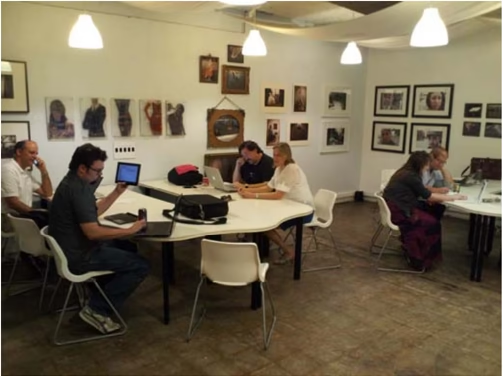
Given that, I certainly do not regret my career and life change. My first year out of law school, I did what was suggested: leased an office, set up shop, and spent a lot of time networking. Recently, I gave up that executive suite office and began working in a collaborative workspace (Caroline Collective, 2011) in Houston that houses technology start-ups, artists and designers, and other professionals or small business owners. It’s cheaper, much more fun, and attracts the most interesting people I’ve met in two years in Houston. I’ve greatly expanded my network, assisted in drafting the licensing agreements for the video production (Aptekar Productions) for the Houston 2011 TEDx Conference (TEDx Houston 2011), and am enjoying more of the Houston art community from the collective exposure.
The collaborative workspace has provided more potential clients, friends, and opportunities in a few months than anything I did in the preceding year. And I enjoy a certain coolness factor with younger programmers when they learn I programmed in LISP for my dissertation work on natural language processing. In fact, I was hired by one engineering firm as their attorney when they learned I had programmed on a Symbolics LISP machine, although it had absolutely nothing to do with their work. It gave me credibility. Who says programming doesn’t pay off? (I leave out any references to any earlier COBOL programming experience so as not to diminish being cool.)
It occurs to me as somewhat ironic that I chose to place myself directly into a community that appeals to the young, the collaborative work environment, where I eavesdrop on web app developers. Along the way, I have come to realize that my dream job is to work in technology transfer or commercialization since I have unique experience in managing projects from concept through research and development and into fielded, profitable products in small companies. I know the agony of being a small business owner – being awake at 3 a.m., wondering how I’ll make payroll or trying to license a product with a much larger, international company.
Until that job materializes (if it ever does), I’m consulting, started a solo law practice, and formed a joint venture for some technology-based products. The clients I enjoy the most are tech start-ups who are bootstrapping themselves into existence. These clients like me because I speak their language and have been in their shoes. I also write and lecture on security and privacy, volunteer to speak to women’s technical groups, and continue to learn as much as I can. I plan to sit for the Patent Bar in a few months. I have expanded beyond technical writing to include fiction. When I catch up, I have a few ideas for some blog writing.
Based on my experience, I’d like to offer advice to those women who are mid-life and/or mid-career, wondering ‘What’s next?’
First, these career and life disruptions provide women with unique opportunities to redefine themselves. It’s a step forward, not back, perhaps just not in a straight path. Many want to pursue their dreams before it is too late, and not end their lives like Tolstoy’s character Ivan Ilyich, who, on his deathbed, wonders if his whole life has been wrong. It becomes a very personal quest: What career paths are open to me, and how do I make them happen?
Second, women know that at the end of the day, it’s up to them. We, women, juggle many roles – daughters, students, working wives, mothers, executives, and others depend on us. It’s no surprise that we are ultimately responsible for making our own change happen, and this will be no different. Friends may be supporting, but the change depends on us, and it’s hard. We must be proactive in creating new networks, learning new skills and technologies, and pursuing new opportunities. Notice the redundancy of the word ‘ new ‘? A mid-career or mid-life redefinition is just that: embrace the change and look for the new. You may need to pursue Plans A, B, and possibly down to Z, especially in this wicked economy. I work out of a ‘ collaborative work environment,’ a concept I’d never previously known. I’ve changed how I seek out clients by attending coffee meet-ups targeted to entrepreneurs, entrepreneur bootcamps, or other activities that attract technology start-ups. For fun, I take classes – last fall, I took a community education Russian course, which has led me to meet-ups to practice Russian and to discover a Russian Cultural Center in Houston. For me, these types of activities keep my mind open to new ideas.
While in law school, my networks moved on, and when I finished, I focused on building new networks, not rebuilding those I had . After I took the Bar exam, I read a backlog of ACM and IEEE publications to see what happened during my Doonesbury two-and-a-half-year lunch. For example, the first time I saw the term ‘ fuzzy testing ‘ in cybersecurity, I wondered if it was a standard technology term or just the author’s clever coining of a term.
Third, filter through advice – including this article – about redefinition. If you question that, go back to the preceding point. Many of my friends questioned my sanity in returning to school at my age. Frankly, I questioned my sanity. I already had three degrees and a ten-year investment in universities. I may never recover the financial investment of those lost productive years and law school expenses. I went with my heart. Twenty years ago, I would never have written that statement. I listened to and trusted that inner voice.
Fourth, don’t be afraid to say, ‘I went with my heart.’ My career started in male-dominated environments at a time when women wore masculine, dark colored business suits to fit in. I still remember the only time I cried at work, and I still cringe at the memory. Women of my age learned to suck it up.
As technical women, we tend to live in our heads and take pride in our intellect. Mid-life and career changes are about listening to and using both our hearts and our heads. I continue to go with my heart. I haven’t given up on my dream job, and I’ll find it. In the meantime, my legal work and technical consulting keep me busy and most engaged in meaningful endeavors within working relationships where I am constantly learning. What more can I ask for? There just aren’t enough hours in the day.
Fifth, you’re never too young to think and plan ahead. Time flies: Last winter you were reading an article in this newsletter about having babies while you’re in graduate school (Alexandra Holloway, 2011) or during a challenging computing career, and seemingly it’ll be tomorrow that you’re discussing that very issue with your own adult daughter. None of us knows what the next twenty years will bring in our work or career, but we can continue to add new skills, continue to build the networks that will help us transition into that phase of our life and career, if and when the time comes. This is consistent with Ms Allen’s advice about focusing on your work, and not your career. Careers and job titles will come and go. The real value is in the work that gives us the skills to carry us along.
Sixth, you’re never too old to make changes happen. One of my favorite quotes by an 80-something Bikram yoga teacher, Emmy Cleaves, is ‘ Fear is what makes us old. ‘ Each of us faces fears. I faced fears walking into a first-year law class. What if I failed? The old adage is that insanity is doing the same thing over and over again, expecting different results. We have to change, and doing so requires facing our fears.
With that context, let’s consider some career choices for those women of a certain age. I’ve categorized them on scales of logical and obvious to the logical and less obvious.
Career Paths – the Logical and Obvious
The most logical career paths, or at least the most commonly suggested, for those transitioning out of computing jobs are to teach, volunteer, or run non-profits. Or rather, these choices used to be more logical, assuming one can find paid positions to teach or run non-profits. In this economy, all bets are off. Teach? Yes, and no. It’s not a stretch for former techies to return to the high school classroom to teach high school mathematics or computer technology, depending on the particular programming languages taught. There may be a significant need, although many states will not hire public school teachers who do not have proper academic credentials and certification. With budget cuts, I’m not sure such positions are open. I did consider a teaching adventure, perhaps teaching math on an Indian reservation.
It might be tougher to teach college-level mathematics or computer science at the university level after so many years, and there aren’t many openings that are not tenure-track positions (and looking for someone at the beginning of their career). What is overlooked are the other courses that experienced computing women could teach based on their work experience, such as Entrepreneurship, Leadership, or other university positions, such as working with startup companies in incubators. I find a shortcoming of many universities is that they tend to hire, to their detriment, those with university backgrounds, even in these non-traditional courses.
Career Paths – the Logical and Less Obvious
These are the careers that most women would enjoy because they leverage their technology background. It might require a few steps backwards, but there is plenty of growth opportunity. An emerging job discipline is technology transfer or technology commercialization at both universities and industrial enterprises. Technology commercialization used to be an afterthought on research projects. Increasingly, enterprises incorporate technology transfer/commercialization into research and development to get research fielded faster and as a major revenue source. One must be able to quickly understand technology, particularly something outside of your direct expertise; communicate effectively between the technical and business worlds; evaluate and value intellectual property; pursue creative licensing or start-up opportunities; and facilitate programs to education on intellectual property protection.
Most current technology commercialization job postings prefer a life sciences background, given the explosive growth of biosystems commercialization. However, I think other skills may be preferable to a specific academic background. When I programmed for a PhD group of civil engineers and statisticians conducting fatigue analysis research of structures, I was successful in spite of the fact that I lacked a civil engineering background. I’ve learned that if you love technology, it is not necessary to be an expert in that area. You must be able to quickly grasp concepts, build a business case, and understand the benefits. It’s better to see the big picture rather than focus on the technical details.
Another open career path is to become a Patent Agent. Patent Agents write applications, including the specification and claims, for the U.S. Patent & Trademark Office (USPTO). Patent agents can do everything a Patent Attorney can do except appear in court. Many companies and law firms use patent agents for much of their work. The USPTO requires that potential agents have their Bachelor’s in specific technical scientific disciplines to take the Patent Bar. This work could be done on a part-time or contract basis, and with telecommuting, allows a more flexible schedule. This may be an area where attention to a specialized technical area pays off.
Career Paths – the Risky
Many who have left the corporate computing world take the leap and start their own company. In fact, according to the Small Business Administration, women owners outnumber men by four to one. Further, the largest population of new entrepreneurs are Boomers – those over 50 – male and female. That is, a large number of mid-life women are starting businesses. The business can be a logical extension of a technical career or something completely different. Some consider it too risky, but for many, it’s the only opportunity when shut out of the employment market, which accounts for the large number of Boomer entrepreneurs.
It also represents a secondary, indirect entrepreneur opportunity by consulting with entrepreneurs to fill in business voids. I have found my technology start-up clients, while technically more astute than I, lack the necessary experience that I uniquely provide: running a business, understanding long-term cash flow, negotiating contracts, and protecting intellectual property – in general, understanding business.
While it takes a certain type of individual to take the risk and start their businesses, it also gives one the freedom to define their businesses (and life as they want). I own my two businesses as a single owner and have just started joint development with another company for a specific product. I supply the product vision and marketing; they supply the programming talent. At this stage of my life, I do not want employees and to worry about bringing in enough work to carry everyone. I want businesses that I can operate while traveling anywhere in the world. As a result, I made the business decision to partner with other companies to develop my product ideas. These companies are excited for the opportunity and don’t mind staffing up when projects are funded. For me, the loss of potential profit is more than offset by the freedom and control I enjoy. It’s another one of those heart things.
Final Thoughts
If you’re in your 20s and 30s, start thinking about a career transition now. Discuss this with your friends and associates, male or female. Be open to new ideas and building skills that you may eventually need. One thirty-five-year-old engineer told me her ultimate career goal was to own an art gallery – twenty years or so from now.
If you’re in midlife redefinition, find like-minded people, whether you’re in midlife redefinition or not. I think there are two types of Boomers: those who have redefined their lives and those who will redefine their lives. One of the most interesting groups of women I’ve discovered is The Transition Network (TTN), which has local groups in major cities. I attend in the Houston area where I’ve discovered women who are going through dramatic life changes – losing their corporate positions after long, dedicated careers and questioning if their sacrifices were worth it; becoming widowed; or losing their passion for their current job (as I did). An overwhelming number fear becoming a bag lady, although this is probably unrealistic. Interestingly, many explore their creative side by becoming artists and writers. There is a tremendous group energy that has driven me to continue making my own life changes.
Don’t take anything personally, but don’t be a chump either. I was turned down for one job interview because I couldn’t ‘get in’ to big-name law firm partners. The company was a high-tech legal e-discovery solution based in Silicon Valley, looking to expand into other cities. I had read and knew the technical writings of all but one of the scientific board of advisors. In fact, I had taken courses from two. I could explain the technical problem they were solving, knew the Federal Rules of Civil Procedure and the case law, develop a business case for their technology, and explain why they had the best solution. That all failed to impress the HR Manager, who wanted someone who could ‘get in.’ I failed to name a single partner at a large firm that convinced her I could do this job, although that is no guarantee of an ability to explain why a law firm should be interested in this technology.
Another interview experience was with my PhD graduate school, where I had maintained contacts and had financially supported (note the past tense). After a seven-month process and two interviews for the position of Assistant Vice-President, I received a short rejection email a few days before Christmas from a staff support person with my name wrong. Yes, a small thing – and even an error Facebook makes – but still a thing. Seven months and neither the Vice-President for Research nor his Chief of Staff could take two minutes to write a ‘thanks for the interview.’ My ‘thank you’ e-mails garnered one response – five words back from the Chief of Staff’s iPhone, ‘ Best of luck to you. I compare this with other experiences, even where I was not selected for an interview, and still received much more professional rejections.
On one hand, I could have overlooked the unprofessional slight. It may have been smart to keep those professional contacts. On the other hand, women in computing, young and old, have earned the right to be appreciated and respected professionally. None of us has expended the amount of work – and for many of us, the blood, sweat, and tears of being the first women in the door – to be unappreciated or disrespected. When necessary, we need to stand up and remind others of that. We owe it to ourselves. We owe it to those who come after us to demand professionalism for our chosen profession. And most importantly, we owe it to those women who came before us.
I hope Ms Jean Bartik would have agreed.
References
Caroline Collective. (2011). Retrieved from Caroline Collective.
Holloway, A., Sadowski, C., and Vega, L. (2011, Winter). Babies in Graduate School, Making It Happen. pp. 2-5.
Aptekar Productions. (n.d.).
Bair, B. (2008, Summer ). ACM-W Newsletter, p. 1.
Piatt, B.,, P. d. (2009). Loose Lips Sink Attorney-Client Ships: Unintended Technological Disclosure of Confidential Communications. St. Mary’s Law Journal, 781-818.
Crowley, C., Henry S. Lodge, M., & Sheehy, G. (2007). Younger Next Year for Women: Live Strong, Fit, and Sexy – Until You’re 80 and Beyond. Workman Publishing Company.
deWitte, P. (n.d.). Retrieved from More Magazine
deWitte, P. (2009, January ). ABA Student Lawyer.
Dylan, B. (Composer). (1964). My Back Pages. [B. Dylan, Performer]
Johnson, S. (2010). Where Good Ideas Come From. Riverhead.
Lohr, S. (2011, April 8). Jean Bartik, Software Pioneer, Dies at 86. New York Times, p. A21.
Tate, B. A. (2010). Seven Languages in Seven Weeks: A Pragmatic Guide to Learning Programming Languages. Pragmatic Bookshelf.
TEDx Houston 2011. (n.d.). Retrieved from TEDx Houston 2011
Trudeau, G. (n.d.). Retrieved from https://www.washingtonpost.com/doonesbury/